
Cedar Slatwall for Retail Stores
Cedar slatwall gives a retail wall the warmth and visual depth of cedar while retaining functional grooves for merchandise accessories. The RDUSA option is a manufactured 3D textured slatwall product with a cedar-look surface, not a claim that the panel is made from solid cedar lumber.
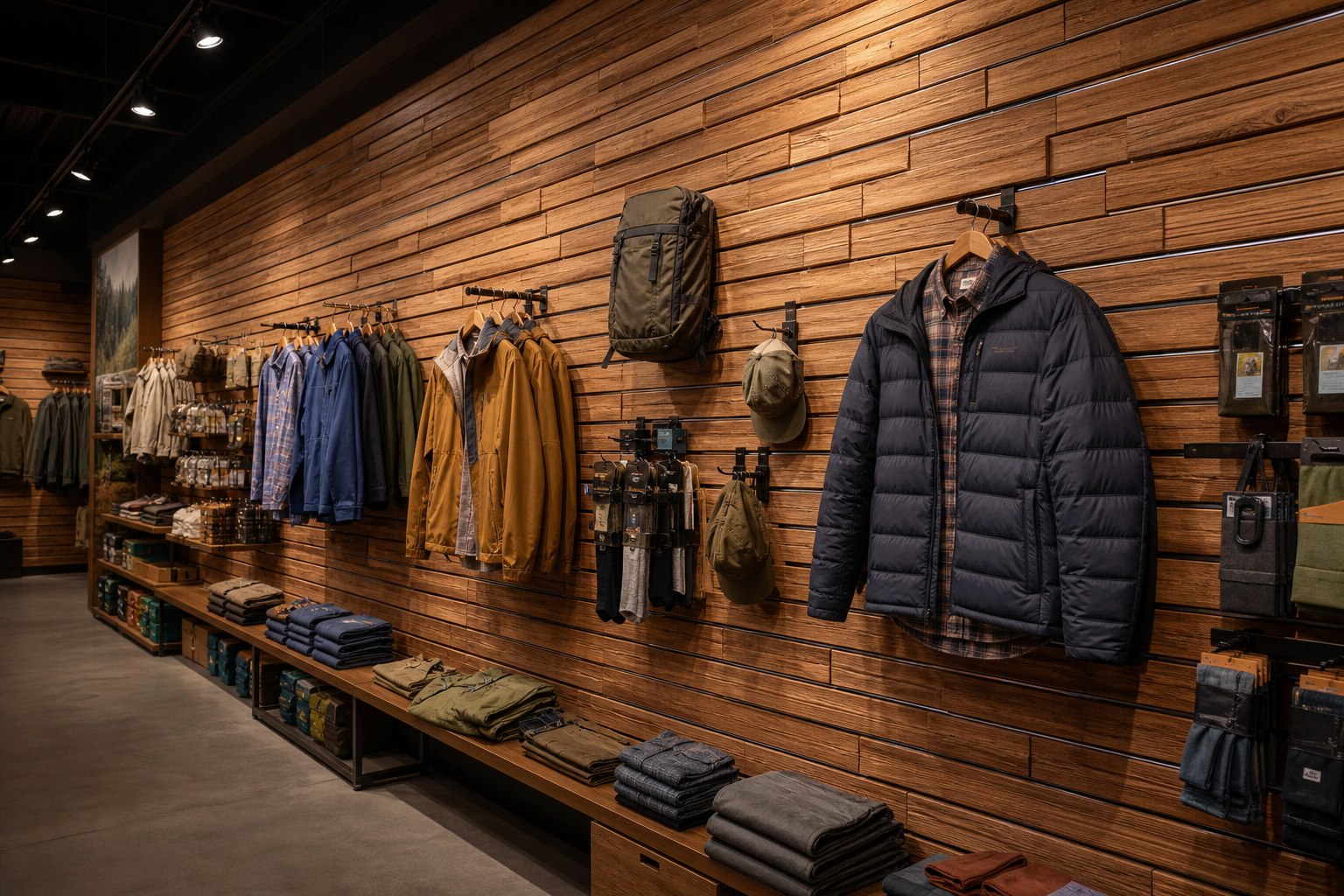
That distinction matters to buyers. A decorative cedar-look merchandising panel should be evaluated as a complete retail wall system: appearance, substrate, groove spacing, inserts, panel format, installation plan, accessory use, freight, and samples.
Cedar Slatwall Buyer Summary
| Option | Best suited to | Planning priority |
|---|---|---|
| Full panel | Efficient installation and continuous wall runs | Seams, backing, and panel layout |
| Individual planks | Offset layouts and a more assembled wood-wall effect | Labor, alignment, and transition details |
| Merchandising panel | Walls carrying hooks, shelves, or faceouts | Insert finish and load planning |
| Coordinating wall panel | Areas needing the same finish without merchandising grooves | Visual continuity and field transitions |
What the RDUSA Cedar Product Is
The Cedar Slatwall product is made with an MDF core and a dimensional cedar-look surface. The current product specification lists a horizontal 2-foot-high by 8-foot-wide configuration, 6-inch-on-center slats, heavy-duty aluminum inserts, and panel or plank format options.
The product page also describes coordinating wall-panel availability for areas that need the same appearance without functional slats. Buyers should verify the current configuration, fire rating, insert finish, lead time, and freight terms at the time of quotation because order details can change.
Where a Cedar-Look Wall Fits
Cedar-look texture suits stores that want a warm, natural, outdoor, handcrafted, or regional atmosphere. Common applications include:
- outdoor and sporting goods stores
- resort and lodge retail
- garden and lifestyle shops
- workwear and heritage apparel
- gift stores and artisan retail
- surf, coastal, and casual specialty stores
The finish is strongest when it supports the merchandise story. It should not be selected only because cedar is visually attractive in isolation. Compare it with flooring, lighting, fixture metal, packaging, and neighboring wall surfaces.
3D Texture Versus a Printed Wood Pattern
A printed flat surface can reproduce wood color and grain, but it does not create the same shadow lines or tactile depth as a formed 3D texture. Under directional retail lighting, the dimensional surface changes as the shopper moves past it. This can make a feature wall feel more architectural.
Texture also needs practical review. Dusting, seam treatment, cut edges, and transitions may require more planning than a simple flat panel. Ask for a physical sample and view it both close up and from the expected customer distance.
Panel or Plank Format
Full panels generally simplify large wall runs because fewer individual pieces need to be aligned. They can be a strong choice when the priority is installation efficiency and a consistent field.
Individual planks allow an offset layout that can resemble an assembled wood wall. That visual flexibility may justify additional installation time in a feature zone, window backdrop, checkout wall, or branded department.
The correct format depends on the wall dimensions and intended seam pattern. Prepare a scaled elevation before ordering so the installer can identify cut locations, outlets, corners, doors, and transitions.
Aluminum Inserts and Merchandise Loads
Inserts reinforce the grooves and influence the wall's appearance. The RDUSA cedar product offers unfinished aluminum or paint-matched insert options. Unfinished silver inserts can create a visible horizontal accent. Paint-matched inserts reduce contrast and keep more attention on the cedar-look texture.
Merchandise load depends on the complete installation, accessory, projection, attachment, and wall structure. Do not treat a published panel figure as permission to load every point on the wall identically. Review the intended product weights, accessory spacing, and backing with the supplier and installer.
Installation Questions to Resolve
Before ordering cedar slatwall, confirm:
- exact wall dimensions and panel orientation
- panel versus individual plank format
- groove and insert finish
- substrate and required wall backing
- corner, base, top, and end transitions
- outlet, switch, and door locations
- accessory types and expected merchandise weights
- non-merchandising coordinating panels
- sample approval and lighting review
- production timing, freight, and site handling
The wider wood-textured slatwall selection is useful when cedar is one of several warm finishes under consideration.
Frequently Asked Questions
Is RDUSA cedar slatwall made from solid cedar?
No. The listed RDUSA product uses an MDF core with a 3D cedar-look textured finish. Buyers should use the product specification rather than assume the name describes the substrate.
Can cedar slatwall hold retail accessories?
Yes. It is a functional slatwall product designed to accept compatible merchandising accessories. Confirm insert, accessory, installation, and load requirements for the planned display.
Are panels and planks both available?
The current product page lists standard panels and individual plank options. Confirm the chosen format and dimensions on the quote.
Can the finish continue into areas without merchandise?
The product page describes coordinating wall-panel options without slats, allowing the visual finish to continue where merchandise grooves are not needed.
Should I order a sample?
Yes. A sample helps the buyer evaluate color, depth, light response, and coordination with other store materials.
Final Recommendation
Choose cedar slatwall when the retail concept needs a dimensional warm wood look and a functional merchandise wall. Verify that the cedar-look surface suits the brand, then resolve panel format, inserts, loads, transitions, and installation details. Browse the wider slatwall range and use Samples and Quotes before committing to a full wall.
Retail Planning Resource
The National Retail Federation publishes retail operations research that can help store teams connect material and fixture choices with the broader customer experience.