
HPL vs LPL Slatwall for Retail Stores
HPL vs LPL slatwall is primarily a finish, budget, and store-role decision. HPL uses high-pressure laminate and is generally selected for a premium custom laminate direction. LPL uses a low-pressure laminate or melamine-faced finish and often provides the more economical route to factory-finished colors, patterns, and wood looks.
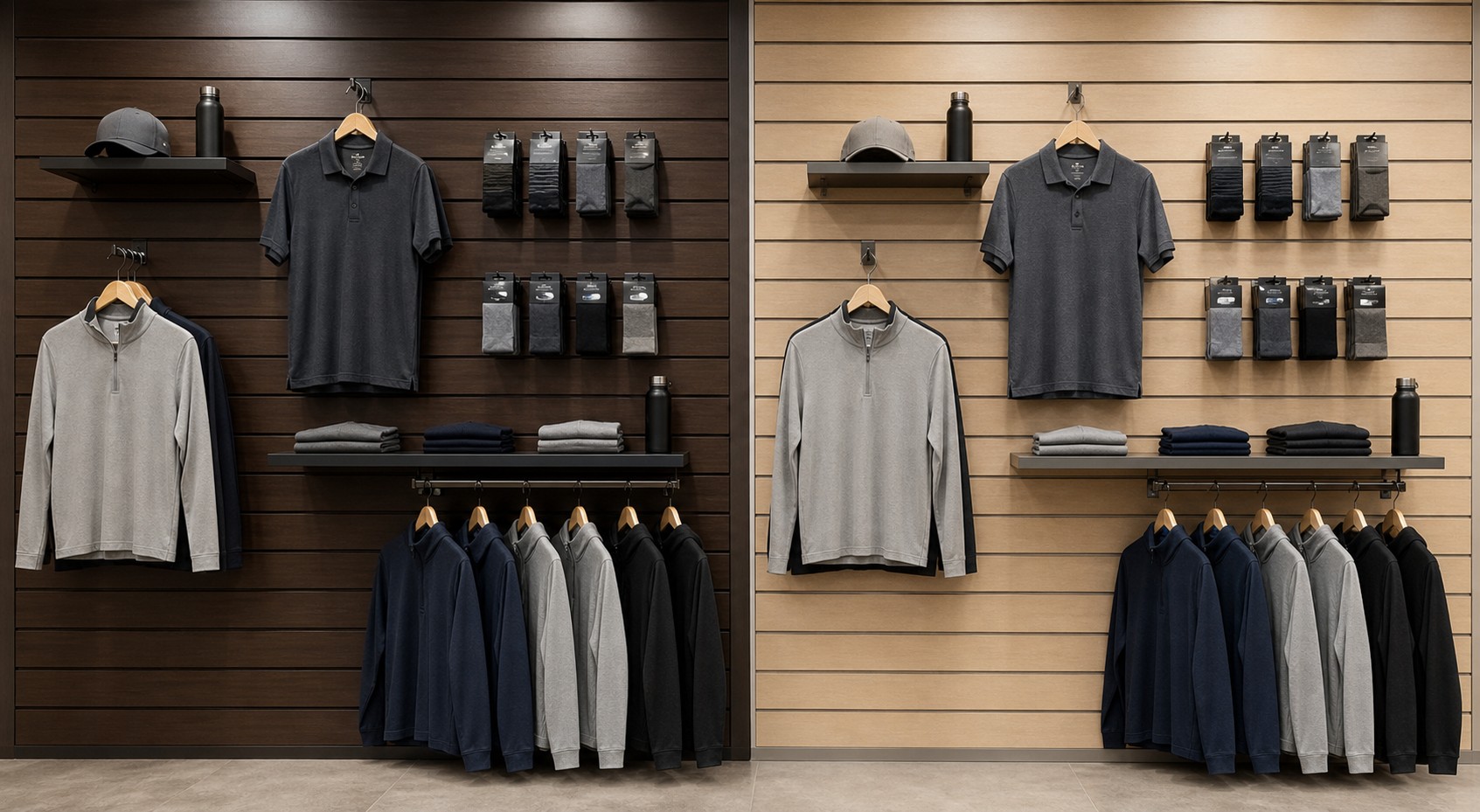
Both can create a functional merchandising wall when the selected panel, inserts, accessories, wall support, and installation match the project. The correct choice depends on where the wall sits, how visible it is, how often it is handled, and whether the finish is a background or a central brand element.
HPL and LPL at a Glance
| Decision factor | HPL slatwall | LPL slatwall |
|---|---|---|
| Finish direction | Premium high-pressure laminate and custom visual specification | Practical factory-applied melamine or low-pressure laminate finish |
| Budget | Usually the higher-cost laminate route | Often the more economical factory-finished route |
| Best visual role | Prominent sales walls, branded departments, and premium customer-facing areas | General retail walls, broad coverage, and merchandise-led departments |
| Finish selection | Selected solid colors, wood grains, and custom laminate directions | Broad solids, patterns, simulated materials, and wood-look choices |
| Main buyer question | Does the wall justify the premium laminate? | Does the available finish meet the design at a better complete cost? |
What Is HPL Slatwall?
HPL means high-pressure laminate. RDUSA's current HPL category positions it as a richer custom laminate option with solid colors, wood-grain directions, and selected specialty looks.
HPL can be appropriate when the wall remains visible between products, the store expects a premium finish specification, or a particular commercial laminate is important to the design. The exact scratch, impact, cleaning, and fire information must come from the selected product and laminate documentation.
What Is LPL Slatwall?
LPL means low-pressure laminate and is commonly associated with melamine-faced panels. RDUSA's LPL range includes a wide selection of colors and decorative patterns.
LPL can be a strong fit for stores that need a finished panel without field painting or premium laminate pricing. It is especially practical where products cover much of the wall and the finish supports rather than leads the visual story.
Compare Finish Quality in the Actual Store
Do not choose from product names alone. Review samples under the planned lighting and place representative merchandise in front of them.
Check:
- color under warm and cool light
- sheen and reflection
- pattern scale
- coordination with counters and floor fixtures
- contrast with packaging and apparel
- visibility of fingerprints or handling marks
The more visible the panel remains after merchandising, the more important finish selection becomes.
When HPL Is Worth the Additional Cost
HPL is easier to justify when:
- the wall is a major customer-facing feature
- the brand requires a selected commercial laminate
- a richer surface or custom finish direction matters
- products leave substantial panel area visible
- the wall belongs in a premium showroom or branded department
The decision should be tied to a design requirement rather than the assumption that the most expensive panel is always best.
When LPL Is the Better Value
LPL may be the better choice when:
- the wall will carry dense merchandise
- broad wall coverage is required
- the selected LPL finish already coordinates with the store
- budget should remain available for accessories, lighting, or other fixtures
- the store needs a ready-finished general merchandising wall
A well-selected LPL wall can look more appropriate than an unnecessary premium surface in a product-dense department.
Compare HPL and LPL With Natural Veneer
Laminate wood looks provide a repeatable decorative pattern. Natural veneer slatwall provides real wood grain and variation and may be stained, sanded, or painted according to current product guidance.
Choose laminate when repeatability, factory finish, and pattern control are priorities. Choose veneer when real wood character and finishing flexibility justify natural variation and additional finish planning.
Cost Is More Than the Panel Price
Compare:
- current panel price and quantity
- inserts and groove configuration
- trim and finished edges
- custom laminate or finish selection
- samples and approval time
- freight and delivery access
- wall preparation and installation
- accessories and merchandise projection
An LPL panel may reduce material cost, while HPL may reduce the need to compromise on a specified finish. Request equivalent quotes before making a decision.
Installation and Accessory Planning
Both panel types require a level layout, suitable supporting wall, product-specific fasteners, clean cuts, finished edges, and compatible accessories. Do not assume the laminate face changes the structural installation requirement or creates a universal load rating.
Confirm the selected panel construction, dimensions, insert options, trim, accessory fit, and installation instructions. Use the separate slatwall installation guide for planning, then rely on current product documentation for the final method.
Store-Type Recommendations
Boutique and Premium Apparel
HPL may be justified where the wall is part of the brand experience. LPL remains practical for secondary or densely merchandised walls.
Gift and General Retail
LPL often provides the best balance of finish variety and budget. Use HPL for a selected feature zone if the design requires it.
Showrooms
HPL can support a more specified, permanent presentation. The product samples and lighting should be reviewed together.
High-Density Packaged Goods
LPL may be sufficient because hooks and merchandise cover much of the panel. Spend budget where it improves navigation, lighting, or fixture function.
Frequently Asked Questions
Is HPL slatwall better than LPL?
Not universally. HPL is the premium laminate route; LPL is often the stronger value for general finished retail walls.
Is LPL the same as melamine slatwall?
LPL is commonly used for melamine-faced panel products. Confirm the construction and finish description of the exact RDUSA product.
Does HPL have more finish options?
HPL supports selected commercial laminate directions, while RDUSA's LPL category also includes a broad range of colors and patterns. Compare current categories and samples.
Which costs less?
LPL generally has the lower material entry point, but current finish, inserts, trim, freight, quantity, and installation determine the complete difference.
Can both use standard slatwall accessories?
They are merchandising panel systems, but accessory compatibility and load guidance must be confirmed for the selected panel and installation.
Final Recommendation
Choose HPL vs LPL slatwall by deciding how much the visible finish contributes to the store experience. Use HPL where a premium laminate is a real design requirement. Use LPL where a broad factory-finished choice and practical budget better support the merchandise. Compare current HPL and LPL slatwall, then request samples and equivalent quotes through Samples & Quotes.
Retail Planning Resource
The National Retail Federation publishes retail operations and store-planning research relevant to fixture investment decisions.