
Slatwall H Units vs Pinwheel Displays for Retail Stores
Slatwall H units vs pinwheel displays is a practical floor-planning decision for retailers who need more vertical merchandise capacity without building another wall. Both are freestanding slatwall fixtures, but their shape changes how customers approach the products, how departments are divided, and how staff replenish the display.
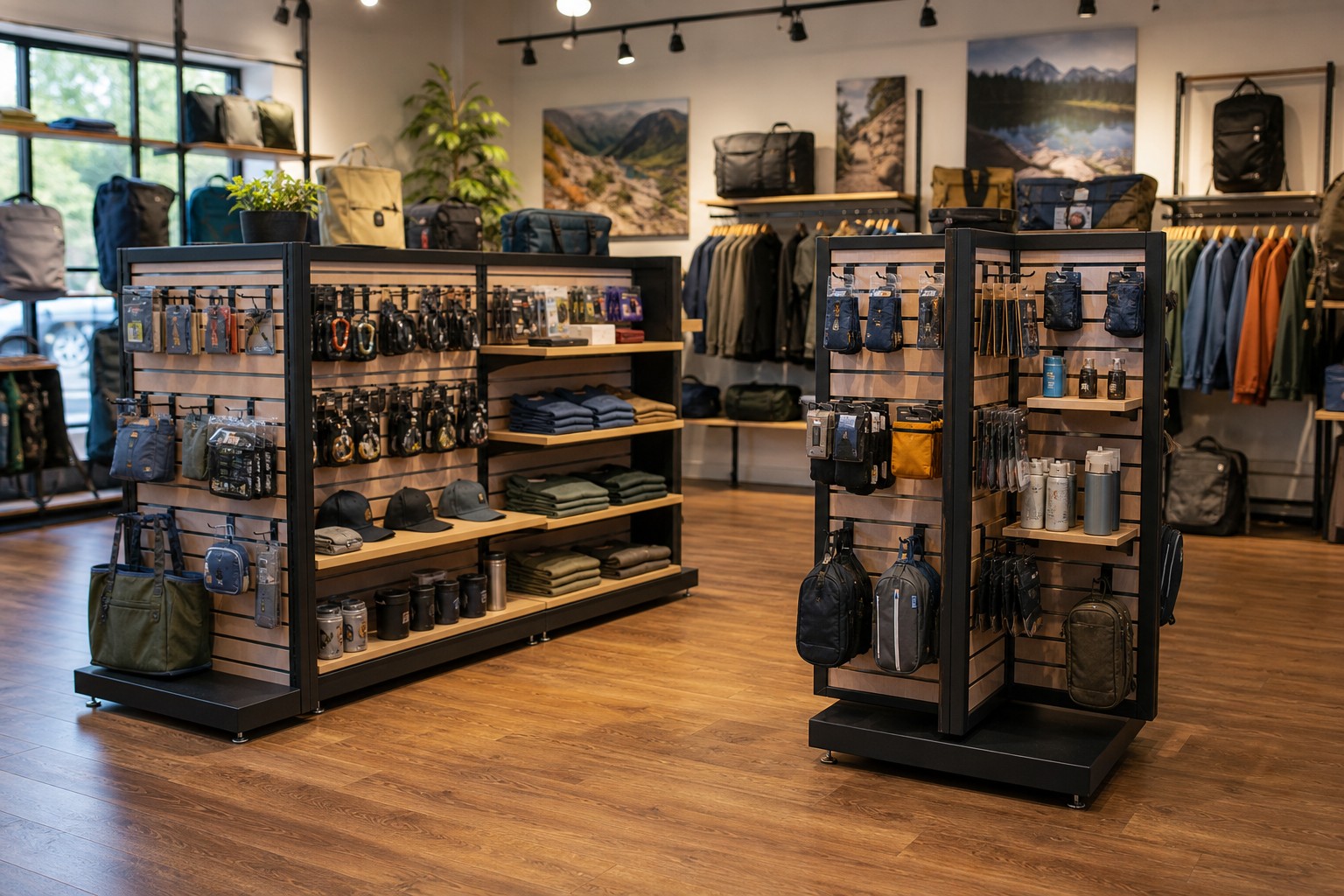
The choice should be based on the merchandise and customer route. Fixture price, material, groove spacing, accessories, and capacity vary by product, so confirm the current model before making a final comparison.
What Is a Slatwall H Unit?
An H-shaped slatwall fixture creates broad display faces connected by a central structure. Depending on the exact model, it can support merchandise on multiple sides and create a substantial island or department boundary.
An H unit is useful when the store needs:
- long, readable merchandise faces
- clear category organization
- a fixture that can define a department edge
- capacity for hooks, shelves, baskets, or other compatible accessories
- a strong central fixture rather than a small feature stand
Because the fixture can occupy a meaningful footprint, it should be drawn into the floor plan with the loaded accessory projection included.
What Is a Slatwall Pinwheel Display?
A pinwheel display arranges several slatwall faces around a central form. It presents products from multiple directions and can divide categories by face.
A pinwheel is useful when the store needs:
- multi-directional shopping access
- separate product stories around one fixture
- strong visibility from several aisles
- compact category segmentation
- frequent product comparison from different approach directions
The angled or rotating visual rhythm can attract attention, but it can also create blind areas or tight corners if the surrounding aisle is not planned.
Compare Customer Approach
An H unit often creates longer, more linear shopping faces. Customers can browse a category along one side and turn to another section. This can make category logic easy to understand.
A pinwheel creates several shorter faces. It can support distinct categories or brands, but signs and product organization must help customers understand what belongs on each side.
Observe the store's natural traffic direction. A fixture with several active faces needs enough open space around it; otherwise some sides will receive little attention.
Compare Merchandise Mix
Use an H unit for product groups that benefit from longer runs, repeated hooks, broader shelf sequences, or clear side-by-side comparison.
Use a pinwheel for smaller categories, complementary product groups, or distinct stories that can each occupy one face.
The current slatwall display fixtures category includes several freestanding formats. Confirm the exact slatwall material, groove spacing, dimensions, panel faces, and accessory compatibility for the selected product.
Plan Accessories Before the Fixture Count
Freestanding slatwall becomes useful through accessories. Build the accessory schedule from the products:
- hooks for packaged or hanging goods
- shelves for boxed, folded, footwear, or premium goods
- baskets or bins for loose products
- faceouts or hangrails for apparel where compatible
- signs for categories, pricing, or wayfinding
Do not assume every standard accessory is appropriate for every fixture or load. Confirm compatibility and product guidance.
Compare Floor Footprint and Aisles
Mark the actual fixture footprint on the floor, then add the projection of shelves, hooks, baskets, products, and customers. A narrow frame can become a much wider loaded display.
The U.S. Access Board's accessible routes guidance is a useful reference for the project team. Confirm local and project-specific requirements before finalizing aisles.
Place the fixture where all intended faces can perform. A side pushed against another display wastes the reason for choosing a multi-sided unit.
Compare Replenishment
An H unit may be easier to divide into larger category zones. A pinwheel may allow each face to carry a smaller, independent assortment.
For either format, staff need a replenishment route and a plan for overstock. Avoid stocking from the customer side during peak periods when possible. Keep fast-moving products on faces that are easy to reach and monitor.
Consider Sightlines and Supervision
Tall or densely loaded fixtures can affect views across the store. Consider customer wayfinding, staff supervision, signs, and the visibility of walls or service areas beyond the fixture.
Use product height and fixture loading to preserve important sightlines. A freestanding slatwall should create a department without making the store feel blocked.
Compare Complete Cost
The fixture is only one part of the purchase. Include required accessories, signs, freight, assembly, floor protection, and installation or setup labor.
A higher-capacity fixture may cost more initially but reduce the number of separate stands. A smaller multi-sided fixture may be more appropriate when each category is limited. Compare the complete plan, not a single unit price.
Common Selection Mistakes
Avoid these errors:
- choosing by shape without a product plan
- ignoring loaded depth
- placing a multi-sided fixture where only one or two faces are visible
- ordering accessories without compatibility confirmation
- using every face at maximum density
- blocking sightlines or customer routes
- failing to plan freight and assembly
Test the Fixture With a Representative Assortment
Before approving several units, stage one face or create a scaled layout using the real product dimensions. Include hooks, shelves, baskets, signs, and the normal amount of merchandise. The test should show the loaded depth and the space a customer occupies while browsing.
For an H unit, check whether long faces remain organized and whether the ends need a separate merchandising role. For a pinwheel, check whether every face is visible from a natural traffic direction and whether staff can replenish inner corners.
Record the approved accessory list by face. This prevents the store from receiving a large fixture with an accessory mix that suits only part of the assortment and gives the merchandising team a repeatable setup for future resets.
Compare Reset Work as Well as Capacity
Ask staff to reset a sample merchandise story on each proposed format. Record how easily they can reach every face, remove accessories, maintain spacing, and replenish product without blocking the aisle. A fixture may provide useful display area but still be inefficient if inner faces are difficult to service or if merchandise hides from the main traffic direction.
Include reset frequency in the decision. A stable department may benefit from long organized faces, while rotating collections may need clearer separation between several small stories. The better choice is the format that supports both the customer view and the staff work required to keep the display complete.
Frequently Asked Questions
Which holds more merchandise, an H unit or a pinwheel?
Capacity depends on the exact product, dimensions, panel faces, accessories, installation, and merchandise. Compare the current models using the same product schedule.
Are freestanding slatwall displays movable?
Freestanding does not automatically mean mobile. Confirm whether the exact fixture is designed to move and follow the supplier's instructions. Do not move a loaded fixture casually.
Can standard slatwall accessories be used?
Many slatwall fixtures are designed for compatible accessories, but groove spacing, material, load, and product guidance must be confirmed for the exact unit.
What should I send for a quote?
Provide the floor plan, available footprint, merchandise types and dimensions, required accessories, preferred fixture format, delivery access, and assembly needs.
Choose the Shape That Fits the Shopping Pattern
Choose an H unit when the store needs longer merchandise faces and strong department structure. Choose a pinwheel when several approach directions and distinct product stories are more important. Validate both options with the loaded footprint and the same accessory schedule.
Compare current RDUSA slatwall display fixtures and use Samples and Quotes to confirm the exact unit, accessories, freight, and setup requirements.