
Barnwood Slatwall for Boutiques and Gift Shops
Barnwood slatwall is a retail wall finish for stores that want warmth, texture, and display function in the same surface. It works especially well in boutiques, gift shops, resort stores, artisan retail, western-inspired concepts, and lifestyle displays where a plain white panel would feel too flat or too anonymous.
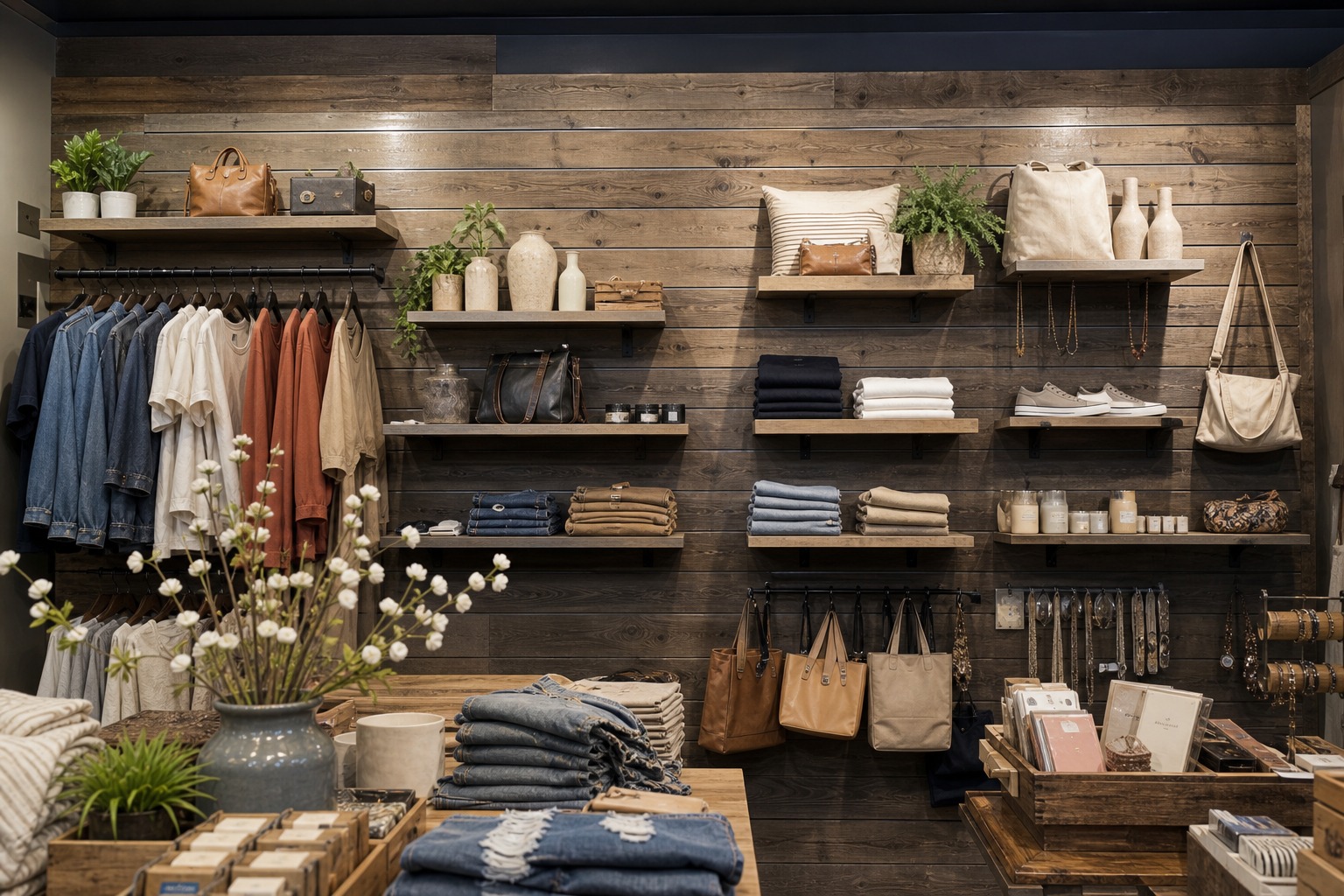
The commercial value is not only the rustic look. A barnwood wall can hold shelves, hooks, faceouts, and other accessories while giving the merchandise a stronger backdrop. Retailers can start with Retail Display USA's barnwood slatwall category, then compare related textured slatwall finishes and compatible slatwall accessories based on the store's products and wall layout.
Why Retailers Choose Barnwood Slatwall
Retailers choose barnwood slatwall when the wall needs to feel like part of the store design rather than a utility surface. The finish can make a product wall feel warmer, more handcrafted, and more connected to a boutique or gift-shop identity.
In a boutique, barnwood can make folded apparel, handbags, denim, hats, and leather accessories feel more curated. In a gift shop, the same finish can support candles, local goods, packaged foods, souvenirs, home fragrance, and seasonal products. Resort stores and artisan retailers often use barnwood because it supports a local, rustic, lodge, coastal, farmhouse, or handmade store story.
The buyer should still think like a fixture planner. Barnwood is not appropriate solely because the finish looks attractive. It should match the merchandise, lighting, traffic path, and accessory plan. If a store sells sleek electronics, luxury cosmetics, or products that need a very clean modern backdrop, a standard panel, metal panel, or another finish will usually be a better fit.
Barnwood Slatwall vs Brick and Standard Slatwall
Barnwood, brick, and standard slatwall can all support retail merchandise, but they send different signals to shoppers.
| Option | Visual Style | Best Store Types | Merchandising Impact | Advantages | Considerations |
|---|---|---|---|---|---|
| Barnwood Slatwall | Warm, rustic, weathered, natural-looking | Boutiques, gift shops, resort stores, artisan retail, home decor stores | Makes the wall feel curated and approachable | Strong backdrop for lifestyle products, accessories, folded goods, and feature walls | Can feel too rustic for very modern or clinical product categories |
| Brick Slatwall | Urban, industrial, architectural | Streetwear, sneaker stores, spirits retail, craft goods, modern boutiques | Adds stronger edge and contrast to the wall | Good for bold feature walls and industrial store concepts | May compete with soft, delicate, or highly colorful merchandise |
| Standard Slatwall | Clean, neutral, functional | General retail, utility walls, dense product areas, back walls | Keeps attention on the merchandise | Flexible, familiar, and easy to use across product categories | Less atmosphere; may not support a branded feature wall as strongly |
For stores comparing finishes, brick slatwall usually creates a stronger industrial look, while barnwood creates a softer retail mood. Standard slatwall is still useful when the store wants products to be the only visual focus.
Best Store Types for Barnwood Slatwall
Boutiques
Boutiques use barnwood best when the wall supports outfit building. A common approach is to use slatwall shelves for folded denim or sweaters, faceouts for key apparel pieces, and hooks for hats, belts, or small accessories. The finish helps the wall feel styled without requiring a custom built-in fixture.
Gift Shops
Gift shops often carry many small categories, so barnwood should organize the wall rather than add visual noise. Shelves can hold candles, boxed goods, local products, and seasonal gifts. Hooks can handle packaged souvenirs, ornaments, kitchen items, or accessories. The wall should help shoppers understand the product group quickly.
Resort Stores
Resort stores can use barnwood slatwall to create a lodge, coastal, outdoor, western, or destination-retail atmosphere. It works well behind branded apparel, caps, drinkware, local gifts, and souvenir products. In this setting, barnwood can reinforce the identity of the place as much as any product category.
Artisan Retailers
Artisan stores and handmade-goods retailers often need a wall that does not feel mass-market. Barnwood can support jewelry cards, leather goods, candles, small decor, pottery accessories, and packaged craft products when paired with the right shelves and hooks.
Home Decor Retailers
Home decor stores can use barnwood behind smaller accents, textiles, fragrance, frames, and giftable products. It is usually strongest as a feature wall or department backdrop rather than the primary surface throughout the entire store.
When Barnwood Is Not the Right Choice
Barnwood is not always the best finish. If the merchandise has very fine detail, high-gloss packaging, or a modern minimalist brand identity, the texture may compete with the product rather than support it. If the store already uses rustic wood flooring, wood tables, and wood shelving throughout, adding a barnwood wall may be too much of the same material language.
Small stores should also think carefully. A full barnwood perimeter can make the space feel visually heavy when every wall has texture. In many layouts, one feature wall or one key department wall is sufficient. Pairing barnwood with standard panels elsewhere helps the rustic finish have more impact where it matters.
Accessories and Textured Finish Planning
Barnwood slatwall should be planned with the accessory package from the beginning. Shelves, hooks, faceouts, baskets, and hangrails change how much of the finish remains visible once merchandise is installed.
For folded apparel, boxed gifts, candles, shoes, or home goods, shelves often make the most sense. For small packaged goods, hooks may be more efficient. For apparel features, faceouts can bring selected pieces forward while the barnwood finish frames the display behind them.
The finish should not be buried under too much hardware. If the goal is to use barnwood as a visual feature, leave enough surface visible between product groups. If the goal is pure capacity, standard slatwall may be the better choice for those sections.
Common Mistakes With Barnwood Retail Walls
The first mistake is using barnwood throughout the store. A rustic finish is strongest when it has contrast. Pairing barnwood with cleaner panels, display tables, or neutral wall sections makes the feature wall feel more intentional.
The second mistake is choosing accessories without considering the finish. Chrome, black, white, or other accessory finishes affect how the barnwood reads in the store. A boutique may want darker or quieter hardware, while a gift shop may prefer brighter accessories for product visibility.
The third mistake is ignoring lighting. Directional lighting can bring out the wall texture, but harsh light may make the surface compete with merchandise. Test the wall area under the store's actual lighting conditions before deciding how much barnwood to use.
The fourth mistake is treating barnwood as decoration only. It still needs to function as a selling wall. Product depth, shelf spacing, hook placement, and staff restocking all matter just as much as they do on a plain panel.
Build a Barnwood Display Wall With RDUSA
A rustic or lifestyle wall can start with RDUSA's barnwood slatwall panels. To compare other finish directions, review the broader textured slatwall category and the related brick slatwall option.
For the merchandising package, compare slatwall shelf accessories and the full slatwall accessories category. The best buying sequence is to choose the wall role first, confirm the finish, then select shelves, hooks, faceouts, or hangrails based on the products that need to sell from that wall.
FAQ
Is barnwood slatwall suitable for apparel stores?
Yes, barnwood slatwall works well in apparel stores when the brand has a rustic, boutique, outdoor, western, resort, or lifestyle direction. It is especially useful behind folded denim, sweaters, jackets, hats, handbags, and accessories. For very modern or minimalist apparel brands, a cleaner slatwall finish will usually be a better match.
Does barnwood slatwall work with shelves and hooks?
Barnwood slatwall is designed to function as a merchandising wall, but buyers should confirm accessory compatibility before ordering. Shelves are useful for folded apparel, boxed gifts, candles, shoes, and samples. Hooks are better for packaged goods, hats, belts, and small accessories.
Is barnwood or brick slatwall better for boutiques?
Barnwood is usually better for boutiques that want warmth, softness, and a curated lifestyle feel. Brick slatwall is stronger for boutiques with an urban, industrial, sneaker, streetwear, or modern edge. If the merchandise is soft goods, gifts, or artisan products, barnwood is often the more appropriate starting point.
How much texture is too much in a small store?
In a small store, barnwood is often most effective on a single feature wall, checkout backdrop, apparel wall, or gift wall — not on every surface. Too much texture can make the store feel smaller or visually busy. A balanced layout might use barnwood on one key wall and standard slatwall elsewhere.
Can barnwood slatwall be used on feature walls only?
Yes. Feature wall use is often the most effective approach. A barnwood feature wall can highlight new arrivals, local products, seasonal merchandise, premium accessories, or a boutique outfit story, while the rest of the store uses simpler fixtures.
What accessories look best with barnwood slatwall?
The best accessory finish depends on the store concept. Darker hardware can create a more rustic or boutique feel, while brighter accessories may keep products easier to see and identify. Shelves, hooks, faceouts, and hangrails can all work well, but buyers should confirm accessory fit and load expectations before ordering.
Retail Planning Resource
For broader retail planning context, the National Retail Federation publishes retail industry research and store operations insights that can help store owners connect fixture decisions with shopper behavior.