
Creative Gridwall Panel Uses for Flexible Displays
Creative gridwall panel uses extend beyond permanent retail walls. Gridwall can support changing displays for markets, events, studios, workshops, showrooms, stockrooms, and temporary selling areas when the panel, base or mounting method, accessories, and loaded footprint are selected for the actual setting.
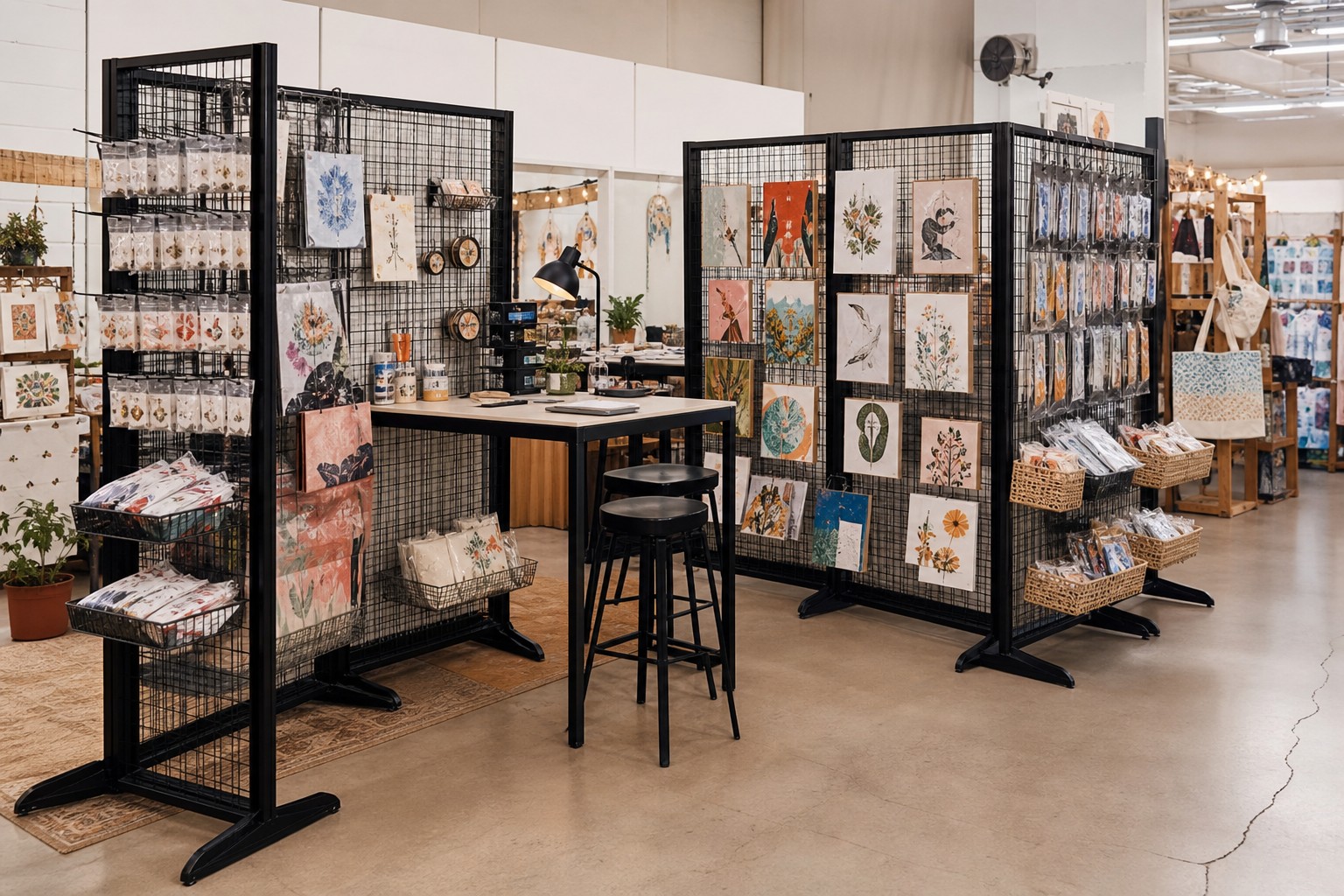
The main advantage is not that gridwall can hold every product. It is that a compatible panel and accessory system can be rearranged as the assortment or activity changes. That flexibility is useful where a permanent built-in display would be difficult to justify.
Buyers should still treat the setup as a complete fixture system. Review current grid panels, confirm whether the intended panel is wall-mounted or freestanding, and verify each accessory before ordering. Similar-looking components should not be assumed to be interchangeable.
Quick Use-Case Comparison
| Setting | Useful gridwall role | Main planning check |
|---|---|---|
| Markets and pop-ups | Compact product presentation that can change between events | Transport, setup, base footprint, and venue rules |
| Trade and community events | Vertical display for samples, accessories, or information | Loaded stability, aisle projection, and visitor flow |
| Studios and maker spaces | Visible organization for tools, materials, or finished work | Accessory compatibility and separation of work and visitor zones |
| Workshops and stockrooms | Organized storage for suitable packaged or hanging items | Item weight, access frequency, labels, and safe installation |
| Showrooms | Flexible sample or accessory presentation | Visual hierarchy and a clear route to product information |
Gridwall for Markets and Pop-Up Shops
Market sellers often need to present many small products within a limited footprint. A vertical gridwall display can help move suitable merchandise off a table and closer to eye level. Hooks may suit packaged items with hanging openings, while baskets or shelves may suit products that cannot hang reliably.
The display should be planned around the event sequence:
- transport the components
- assemble the fixture correctly
- load merchandise without creating instability
- keep the booth entrance clear
- replenish during the event
- pack down without damaging products or components
A fixture that works in a permanent store may be inconvenient for repeated transport. Confirm dimensions, component count, assembly requirements, and the intended use of the selected products before treating them as a mobile event system.
Gridwall for Art, Craft, and Maker Studios
Studios can use gridwall to separate display inventory from active work surfaces. Finished pieces, packaged craft products, tools, or samples can be grouped vertically so the table remains available for production or customer demonstrations.
Use clear zones. Keep frequently handled tools near the work area, finished retail products in the customer-facing area, and fragile or unsuitable items on an appropriate shelf or in another fixture. Gridwall should improve organization, not encourage every object to be hung simply because an attachment is available.
For changing assortments, the broader gridwall accessory selection can help buyers compare hooks, faceouts, and hangrails. Confirm the exact panel and attachment for every component.
Gridwall for Workshops and Organized Storage
In a workshop or stockroom, visibility can be more important than decorative presentation. Gridwall may help organize suitable packaged supplies, lightweight accessories, or frequently used items that need a consistent return location.
Labeling and spacing matter. Leave enough room to remove one item without disturbing the next. Place frequently used items within practical reach and avoid loading a lower or upper area in a way that creates an awkward lifting or retrieval task.
This is not a substitute for engineered industrial storage. Do not publish or rely on general load claims. Confirm the selected panel, attachment, installation, and product-specific guidance for the intended merchandise.
Gridwall for Showrooms and Sample Displays
Showrooms need to help buyers compare options without turning the wall into a stockroom. Gridwall can support samples, packaged accessories, swatches, or related components when the display follows a clear comparison sequence.
Group items by customer decision:
- product family
- compatible accessory
- size or format
- finish or color
- use case
Use signs or labels where appropriate, but make the physical order understandable without requiring a long explanation. A strong showroom display should lead naturally from the sample to the product page, staff conversation, or quote request.
Gridwall for Events and Information Displays
Community events, school activities, exhibitions, and temporary information zones may use gridwall for photographs, lightweight printed material, packaged items, or demonstration accessories. The exact attachment and intended load still need confirmation.
Avoid placing projecting accessories where people enter, turn, or queue. Measure the loaded fixture, not only the empty panel. If children or large crowds will be present, the setup requires especially careful venue and stability review.
Choose Accessories by Item, Not by Theme
The setting does not determine the accessory; the item does. Use hooks for suitable packaged merchandise, baskets for contained loose items, shelves for products that need a flat surface, and faceouts or hangrails for compatible hanging goods.
Review grid accessories alongside gridwall panels. Measure representative products before deciding how many facings or accessory rows are practical.
Plan the Loaded Footprint
Freestanding gridwall occupies more space after products and accessories are added. Hooks project into the aisle, baskets add depth, and hanging apparel can extend beyond the empty fixture.
Mark the proposed footprint on the floor before ordering. Include:
- the base or support
- the panel
- the longest accessory
- the merchandise depth
- customer standing space
- staff replenishment access
This simple check can prevent a flexible display from becoming an obstruction.
Common Mistakes
The first mistake is assuming every gridwall component fits every panel. Verify compatibility.
The second is treating maximum density as the goal. A display can hold many items and still be difficult to shop.
The third is forgetting transport and assembly. Temporary users need a complete setup and pack-down plan.
The fourth is mixing work storage and customer presentation without boundaries. Separate active tools, sellable products, and visitor space.
The fifth is using unsupported capacity or stability assumptions. Confirm product-specific guidance and follow installation or assembly instructions.
Buyer Checklist
- Define the setting and whether the display is temporary or permanent.
- Measure the full available area and customer path.
- Identify representative products and package dimensions.
- Choose wall-mounted or freestanding components appropriate to the setting.
- Match hooks, baskets, shelves, or rails to the actual products.
- Confirm compatibility, dimensions, finish, assembly, and intended use.
- Test the loaded footprint before repeating the layout.
- Plan labels, replenishment, transport, and storage between uses.
Frequently Asked Questions
What are some creative uses for gridwall panels beyond retail?
Gridwall can support suitable displays in markets, events, studios, workshops, showrooms, and organized storage areas. The correct setup depends on the panel, support method, accessories, merchandise, and environment.
Can gridwall be used for a craft show?
It may suit a craft-show display when the selected components are intended for the setup and the loaded fixture fits the booth and venue rules.
Can gridwall hold art or photographs?
Suitable lightweight work may be displayed with compatible accessories, but the attachment, item protection, and product-specific guidance must be confirmed.
Is gridwall suitable for storage?
It can organize suitable items, but it should not be treated as industrial storage without confirmed product and installation guidance.
Are gridwall accessories universal?
Do not assume they are. Confirm the attachment system and intended panel compatibility before ordering.
Final Recommendation
Creative gridwall panel uses work best where the assortment or activity changes and the display needs to be reorganized. Start with the actual products, loaded footprint, and operating sequence, then select the panel and accessories as one system. Review current RDUSA gridwall options and send dimensions, product examples, setup type, and intended use through Samples & Quotes.
Retail Planning Resource
The National Retail Federation publishes retail operations and merchandising research that can support broader display planning.