
Decorative Panels for Retail Stores: Display Guide
Decorative panels for retail stores can be a visual backdrop, a merchandisable wall system, or both. The difference matters. A panel that resembles brick, wood, concrete, metal, or another surface is not automatically designed to accept hooks, shelves, faceouts, or retail accessories.
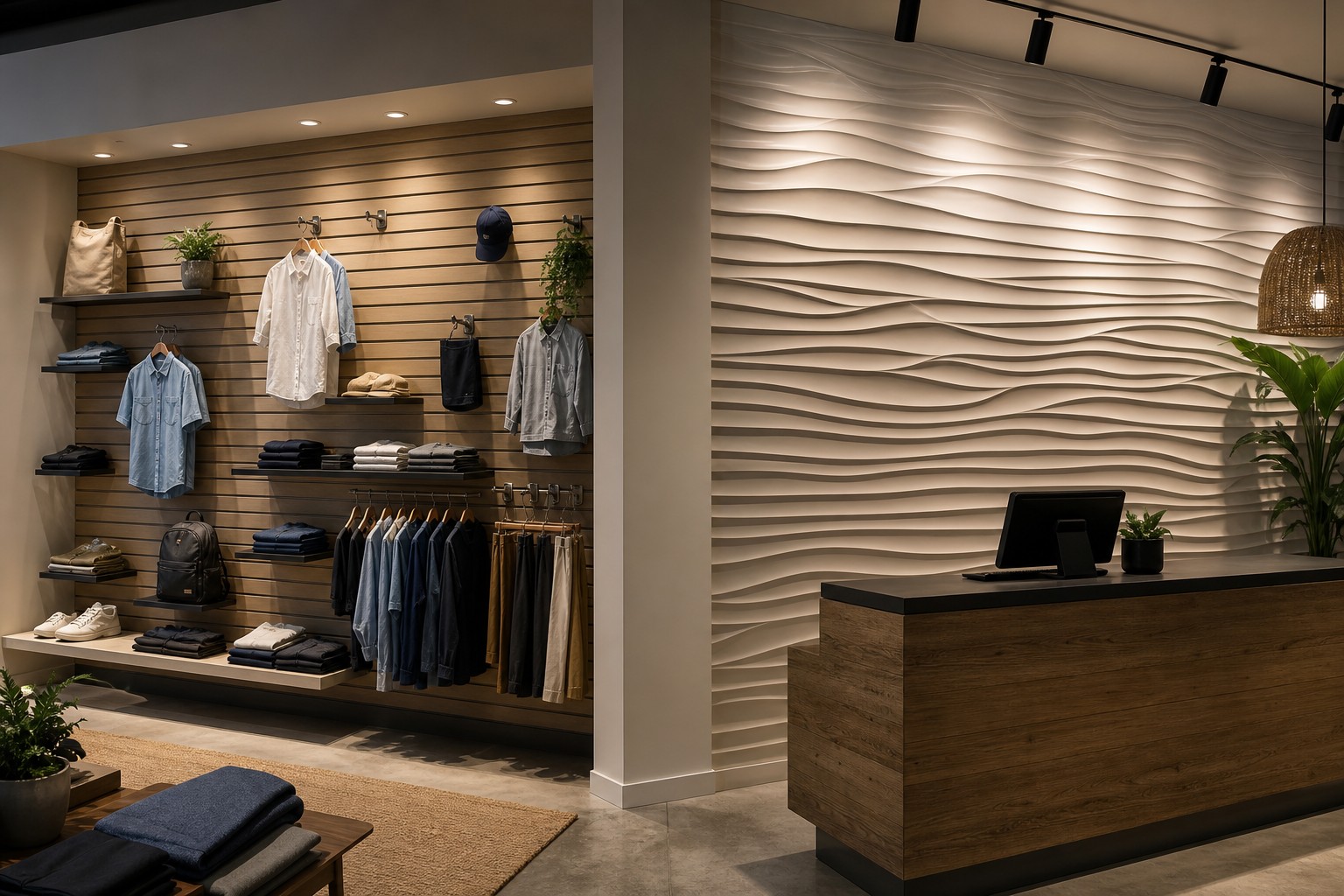
Retail buyers should decide whether the wall's main job is brand atmosphere, product display, or a coordinated combination. That decision separates decorative-only coverings from printed slatwall, laminate slatwall, and true 3D textured slatwall systems.
Decorative Retail Wall Options at a Glance
| Panel direction | Visual effect | Merchandising role | Buyer check |
|---|---|---|---|
| Decorative-only wall panel | Color, pattern, relief, or branded backdrop | Usually atmosphere rather than accessory support | Do not attach merchandise unless the system permits it |
| Printed or laminate slatwall | Flat graphic, color, pattern, or wood-look finish | Uses compatible slatwall accessories | Finish durability, substrate, groove spacing, inserts |
| True 3D textured slatwall | Physical depth and changing shadows | Feature wall and merchandising surface | Accessory clearance, seams, trim, lighting, installation |
| Mixed feature wall | Decorative zones coordinated with display zones | Places product only where the wall is engineered for it | Alignment, transitions, finish consistency, future reset plan |
Ask What the Wall Must Do
Write a one-sentence job for the wall:
- Create a visual backdrop behind the cash desk.
- Display hanging apparel and folded accessories.
- Present packaged products on hooks and shelves.
- Define a branded shop-in-shop zone.
- Continue one finish across display and non-display areas.
If the wall only needs to create atmosphere, a decorative-only panel may be appropriate. If it must hold merchandise, begin with a documented retail display system and then choose the decorative finish.
Decorative-Only Panels
Decorative-only panels can transform counters, fitting-room approaches, waiting areas, window backdrops, and non-merchandised brand walls. They may use printed graphics, molded relief, wood, composite materials, metal, acrylic, or other finishes.
Their strength is visual freedom. Their limitation is that appearance does not prove accessory compatibility or merchandise capacity. Avoid drilling hooks or brackets into a decorative covering unless the product and supporting wall are designed for that use.
When a store wants the same look across display and non-display areas, ask whether the finish family includes coordinated merchandisable and plain wall-panel options.
Printed and Laminate Slatwall
Printed or laminate slatwall creates a finished merchandising wall while keeping the surface comparatively flat. It can suggest wood, stone, color, or another pattern without producing deep physical relief.
RDUSA's LPL slatwall range provides factory-finished color and pattern directions. Buyers can also compare other materials through the main slatwall category.
Flat finished slatwall may be the better option when:
- Merchandise needs to sit close to the wall.
- Dense hook layouts are planned.
- The wall should remain visually quiet.
- Budget favors a conventional finished panel.
- Seam and trim simplicity are priorities.
True 3D Textured Slatwall
True 3D textured slatwall combines physical relief with horizontal merchandising grooves. Raised and recessed forms create real shadows that change with viewing angle and store lighting.
RDUSA's textured slatwall range includes visual directions such as brick, barnwood, concrete, patterned, metal-look, and weathered wood. Review exact product construction rather than assuming every texture uses the same panel format.
The related textured slatwall guide explains the broader category.
True texture is especially useful when:
- The wall is a major brand element.
- Shoppers see it from multiple angles.
- Directional lighting can reveal the relief.
- The store wants material realism rather than only a printed pattern.
- The feature wall must also merchandise products.
Compare Brick and Barnwood Directions
Brick slatwall can support industrial, urban, sports, streetwear, automotive, and heritage concepts. Its stronger pattern requires careful product spacing so hooks and shelves do not make the wall visually crowded.
Barnwood slatwall can support rustic, artisan, outdoor, gift, western, resort, and natural-product environments. Compare sample color variation and texture with the actual merchandise.
Neither direction is universally better. The product color, lighting, store size, and desired brand tone should decide.
Plan Accessory Clearance
Physical texture changes the relationship between the wall and accessory. Check whether a hook, bracket, shelf, faceout, or sign holder clears raised areas and presents products at the intended angle.
Create a sample merchandising bay with:
- The selected panel and finish.
- The exact insert option when applicable.
- Planned hooks and shelves.
- Representative merchandise.
- Store lighting.
- Proposed spacing.
This test is more useful than approving an empty panel sample by itself.
Use Lighting to Reveal, Not Flatten
Front-on diffuse lighting can make deep texture appear flatter. Directional light from above or the side creates shadow and reveals relief. Strong lighting can also exaggerate seams, glare, or surface variation.
Test the panel under the actual color temperature and fixture direction. Review it at opening-hour brightness and under any evening or feature lighting scene. Keep labels and product faces readable even when the wall receives dramatic light.
Compare Installed Cost
Decorative wall cost can include:
- Panel or profile price.
- Inserts and accessories.
- Trim and transitions.
- Substrate preparation.
- Freight and packaging.
- Field cuts.
- Installation labor.
- Lighting changes.
- Replacement material.
- Future reset limitations.
A decorative-only panel may appear less expensive but still require a separate merchandise system. A display-ready decorative slatwall may combine two jobs and justify a higher material cost. Compare the complete wall function.
Buyer Checklist
Before ordering decorative panels for retail stores, confirm:
- Decorative-only or display-ready role.
- Exact panel construction.
- Physical texture or printed appearance.
- Approved accessories and inserts.
- Product and accessory clearance.
- Supporting wall and fasteners.
- Seams, corners, trim, and transitions.
- Lighting and sample approval.
- Cleaning and repair guidance.
- Freight, lead time, and replacement process.
Frequently Asked Questions
Are decorative wall panels the same as slatwall?
No. Decorative wall panels may only provide a finished surface. Slatwall is a merchandising system with grooves intended for compatible accessories. Some textured slatwall products combine both functions.
Can merchandise hooks be installed on any decorative panel?
No. Use hooks only with a system and supporting wall approved for the intended accessory and load. Appearance does not establish capacity.
What is the difference between printed and 3D textured slatwall?
Printed slatwall uses a flat surface graphic or pattern. True 3D textured slatwall has physical raised and recessed forms that create real shadows.
Are textured panels suitable for every product?
Not automatically. Strong texture may compete with small packaging, and raised areas can affect accessory clearance. Test the actual products and accessories on a sample bay.
Can decorative-only and display-ready panels be used together?
Yes. A mixed wall can use merchandisable panels in selling zones and coordinated decorative panels elsewhere. Plan transitions, finish matching, and installation details before ordering.
Final Recommendation
Choose decorative-only panels when the wall is primarily a backdrop. Choose flat finished slatwall for efficient merchandising with a quieter surface. Choose true 3D textured slatwall when physical relief and product display must work together as a feature wall.
Use Samples & Quotes to compare finish samples, panel formats, accessories, trim, freight, and the intended merchandising layout.
Retail Planning Resource
The U.S. Department of Energy explains lighting characteristics and efficiency considerations that can support a broader retail lighting review. Final lighting and electrical design should follow project-specific requirements.