
Mobile Sales Floor Tables: Retail Buyer Guide
Mobile sales floor tables help retailers change product stories without rebuilding the whole floor plan. A rolling table moves on casters, nesting tables expand or compress as a group, and hinged tables support breakdown and storage. Those are different kinds of flexibility, so the right table depends on how, why, and how often the store resets.
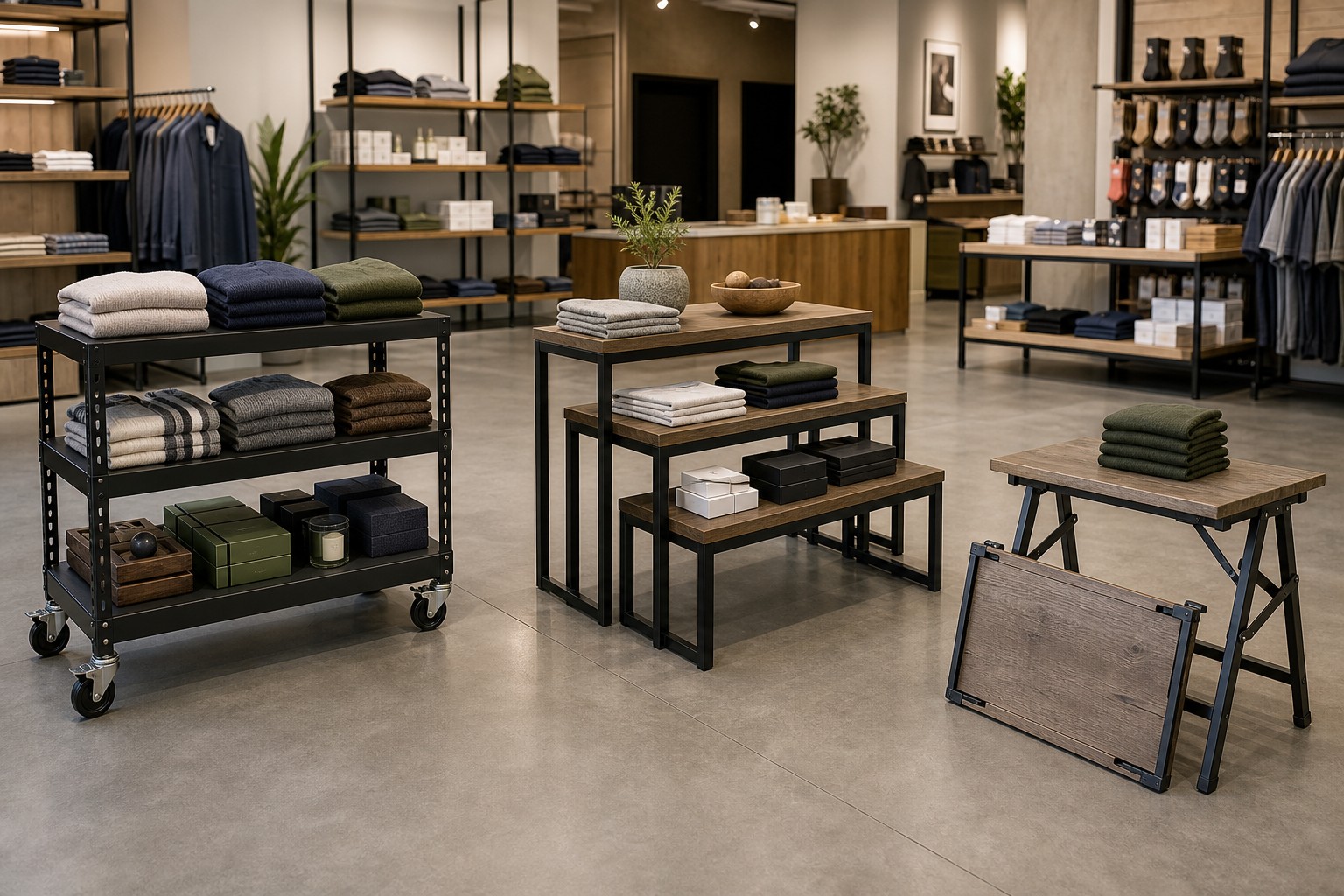
GSC data shows demand around mobile sales floor tables while RDUSA already offers rolling, nesting, tiered, round, square, and knock-down hinged options. This guide maps the search phrase to real fixture formats and helps buyers compare movement, merchandising capacity, storage, customer access, and complete operating cost.
Flexible Display Tables at a Glance
| Format | How it changes | Best use | Main buyer check |
|---|---|---|---|
| Rolling tiered table | Moves as one fixture on casters | Frequent floor resets and high-visibility assortments | Caster type, loaded movement, shelf access, total footprint |
| Nesting tables | Separate, overlap, or compress into a smaller zone | Seasonal volumes and coordinated product stories | Individual sizes, finish consistency, storage arrangement |
| Hinged table | Breaks down or folds for storage and transport | Pop-ups, events, temporary departments, spare fixtures | Assembly, locking method, stored size, top dimensions |
| Fixed tiered table | Merchandise changes, fixture usually stays in position | Stable permanent feature zones | Shelf visibility, reach, assembly, and aisle clearance |
What Does Mobile Mean for the Store?
Buyers often use "mobile" to describe any table that helps a floor plan change. In practice, three different needs are involved:
- Rolling mobility: the assembled table moves on wheels.
- Layout flexibility: several nesting tables rearrange into different footprints.
- Storage mobility: a hinged table breaks down for transport or off-floor storage.
Define the workflow before selecting the fixture. A table moved twice a day has different requirements from one rearranged for quarterly seasonal launches.
Rolling Tables for Frequent Resets
A rolling display table keeps multiple levels of merchandise together while the fixture changes location. This can reduce the handling required during resets, although stores should confirm whether the selected table may be moved while loaded.
The RDUSA Rolling Three Tier Table uses a black frame, black laminate surfaces, three shelf levels, and dual-wheel casters. The tiered format creates vertical visibility for folded apparel, boxed products, gifts, or coordinated assortments.
Before choosing a rolling table, check:
- Whether the casters lock.
- Whether the table is intended to move while loaded.
- How products are contained during movement.
- Whether lower shelves remain reachable.
- The complete turning path through the store.
- Floor transitions, thresholds, and surface conditions.
Mobility is useful only when the route and reset process support it.
Nesting Tables for Variable Inventory
Nesting tables do not need casters to create a flexible display. Their different heights and compatible footprints let retailers spread a presentation across the floor or compress it as inventory sells down.
This works well for seasonal gifting, folded apparel, shoes, home goods, and coordinated collections. Products can be divided by style, price, size, or color while still reading as one story.
Review RDUSA's nesting table options and record the dimensions of every table in the group. A nesting set should be measured in both its expanded selling arrangement and its compressed position.
Nesting tables are usually moved as individual pieces rather than as one loaded fixture. Plan staff handling and product transfer accordingly.
Hinged Tables for Storage and Events
Hinged or knock-down tables serve stores that need a usable selling surface without permanently dedicating floor space. They can support pop-up departments, clearance events, trunk shows, holiday volume, and temporary promotional areas.
The important comparison is not simply whether the table folds. Confirm:
- Set-up and breakdown steps.
- Hardware or locking points.
- Required tools.
- Stored dimensions.
- Staff handling weight.
- Top size and intended merchandise.
- Frequency of assembly.
A lower purchase price is not a good value if frequent assembly creates avoidable labor or if the stored fixture is still too large for the available backroom.
Tiered Tables Improve Product Visibility
Tiering lifts products behind the front row so shoppers can see more of the assortment. It can also create a strong central feature without the visual mass of a single tall fixture.
RDUSA's Aspect Display System includes three-tier retail display tables with expanding lower levels to increase access and display area. Compare this type of fixed or adjustable tiered fixture with a rolling table based on whether mobility or display density is the higher priority.
For small products, place the strongest visual story on the upper level and keep frequently handled stock within comfortable reach. Avoid loading the lower shelves so densely that products disappear from the customer view.
Compare Complete Operating Cost
The purchase price is only one part of the decision. Include:
- Freight and assembly.
- Staff time for resets.
- Storage space.
- Product handling during movement.
- Replacement casters or hardware.
- Finish maintenance.
- Lost selling space around an oversized fixture.
- The number of seasonal displays one table can replace.
A more flexible table may justify a higher initial cost if it replaces several single-use fixtures. The opposite is also true: a fixed table may be the better value when the layout rarely changes.
Match the Table to the Product
Folded apparel benefits from broad, reachable surfaces. Boxed goods need enough depth and a layout that preserves label visibility. Fragile products may need containment or a stationary display. Small gifts benefit from tiering but can become visually noisy when too many units are placed together.
Use the broader RDUSA display table category to compare round, square, nesting, tiered, rolling, hinged, glass, laminate, wood-look, and metal directions. The related retail display table buyer guide covers general table selection.
Buyer Checklist
Before ordering, document:
- Reset frequency.
- Whether the table must roll while assembled.
- Product type, depth, and expected load.
- Required customer access from each side.
- Expanded and stored footprint.
- Caster, leveler, hinge, and assembly details.
- Finish and cleaning requirements.
- Backroom and doorway clearances.
- Freight and replacement-part questions.
Frequently Asked Questions
What are mobile sales floor tables?
They are display tables selected for changing retail layouts. The term may include tables on casters, nesting table sets that reconfigure, and hinged tables that break down for storage.
Are rolling retail tables safe to move while loaded?
Do not assume they are. Confirm the product instructions, caster design, floor route, and loading guidance. Fragile or unstable merchandise should generally be removed before movement unless the supplier states otherwise.
Are nesting tables considered mobile?
They are layout-flexible rather than necessarily wheeled. Each table can be repositioned, and the group can expand or compress as inventory changes.
When is a hinged display table useful?
Hinged tables suit temporary departments, pop-ups, events, seasonal overflow, and stores that need to return the floor area to another use.
Is a three-tier table better than a flat table?
It is better when vertical visibility and product separation matter. A flat table may be better for large products, broad folded stacks, or displays that require one continuous surface.
Final Recommendation
Choose rolling mobile sales floor tables for frequent whole-fixture moves, nesting tables for flexible assortment footprints, and hinged tables for temporary selling periods and storage. Confirm dimensions and movement procedures before treating any table as mobile.
For planning help, use Samples & Quotes and provide the store footprint, doorway dimensions, reset frequency, product type, and preferred finish.
Retail Planning Resource
The National Retail Federation publishes retail operations research that can support broader decisions about store formats, staffing, and merchandising change.