
PVC Slatwall vs MDF Slatwall: Which Should Retailers Use?
PVC slatwall vs MDF slatwall comes down to environment, finish priorities, handling, and the exact merchandising system. PVC is generally the stronger candidate where moisture resistance and lighter sections matter. MDF-based slatwall generally offers the broader traditional and decorative retail finish direction. Buyers should confirm load, insert, fastening, and installation details for the exact product rather than applying one material claim to every panel.
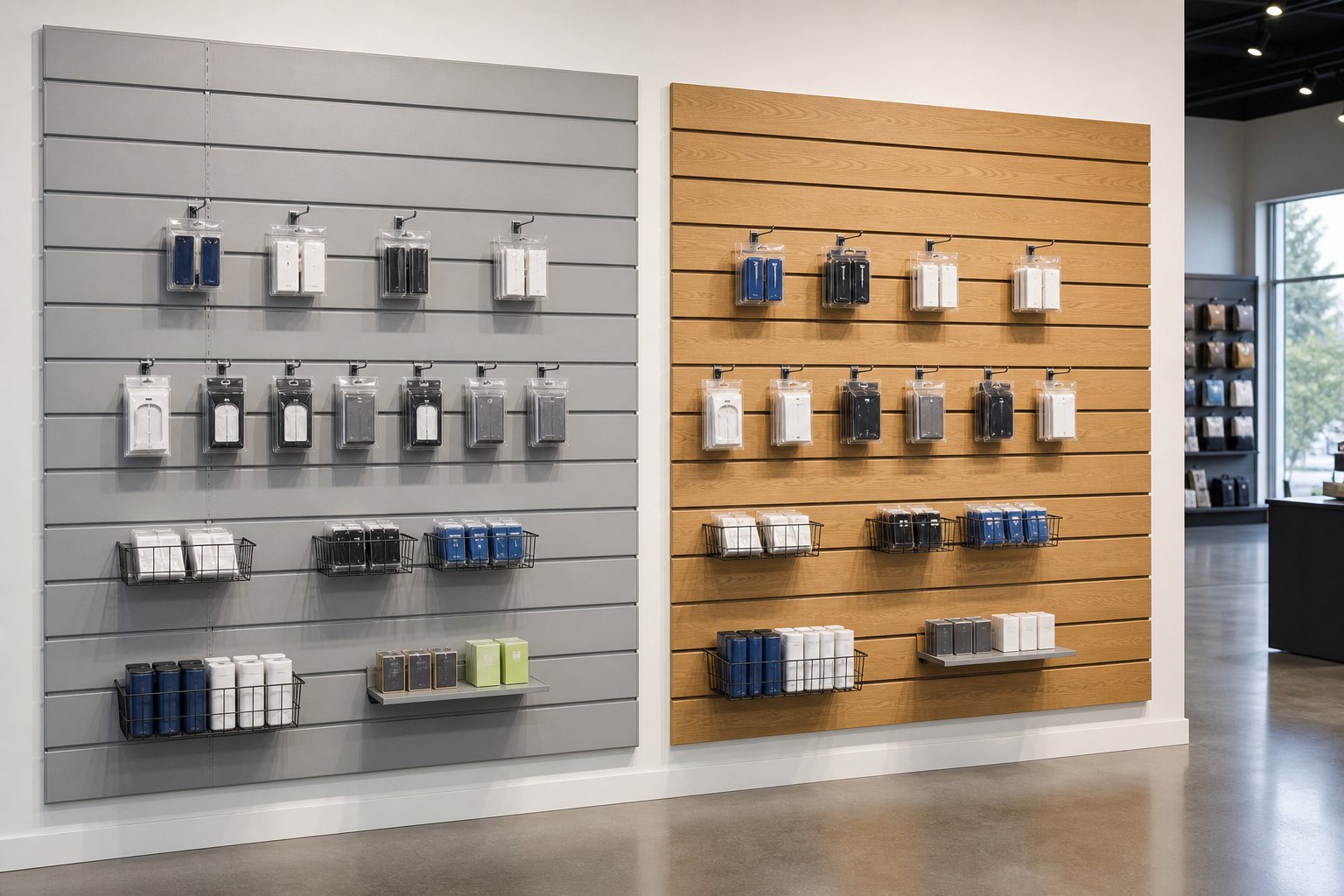
This guide compares buying priorities, not universal engineering specifications or a promise that every supplier has a current PVC line. Buyers should use it to narrow the material decision first, then confirm what is actually available through the current slatwall quoting process.
PVC vs MDF Slatwall at a Glance
| Decision factor | PVC slatwall | MDF-based slatwall |
|---|---|---|
| Environment | Useful where moisture exposure is a concern | Common for conditioned interior retail spaces |
| Handling | Often selected for lighter section handling | Panel handling depends on size and construction |
| Finish direction | Focused plastic finish and color options | Broad paint, laminate, veneer, and textured directions |
| Installation format | May use interlocking sections | Often supplied as panels or product-specific planks |
| Main buying question | Does the environment justify PVC? | Which finish and panel family fit the store? |
When PVC Slatwall Is the Better Choice
RDUSA describes its PVC slatwall as water and moisture resistant and suitable for environments such as outdoor retail kiosks and specialty framed wall fixtures. That makes PVC worth considering when the display area may experience humidity, occasional moisture, or conditions that are less suitable for standard interior panels.
PVC can make sense for:
- outdoor or semi-exposed retail kiosks
- seasonal environments where humidity varies
- framed display sections that benefit from lighter components
- utility-oriented retail zones
- buyers who prefer an interlocking section format
Do not translate moisture resistance into an unlimited outdoor-use claim. Confirm exposure, temperature, UV, support, and installation requirements for the exact location.
When MDF-Based Slatwall Is the Better Choice
MDF-based slatwall remains common in retail because it supports many visual directions. RDUSA's broader catalog includes paint-grade, laminate, veneer, and 3D textured options, giving buyers more ways to make the wall part of the store design.
MDF-based slatwall can make sense for:
- boutiques and apparel stores
- gift, home, and lifestyle retail
- large conditioned interior wall runs
- projects requiring decorative or wood-look finishes
- stores that want a familiar panel-based merchandising surface
The correct choice still depends on the exact panel family. Construction, inserts, dimensions, finish, and installation instructions vary.
Compare Moisture and Location First
Location is the fastest way to narrow the decision. If the display sits in a conditioned interior with controlled humidity, finish and merchandising needs may matter more than moisture resistance. If the wall is near an open storefront, kiosk opening, wet product area, or variable environment, PVC deserves closer review.
Document:
- indoor, outdoor, or semi-exposed location
- expected humidity and cleaning conditions
- direct water or splash risk
- temperature variation
- wall substrate and support
Send those details to RDUSA before assuming a material is suitable.
Compare Finish and Brand Requirements
PVC should be chosen because its material and format fit the project, not because buyers expect it to imitate every decorative MDF finish. RDUSA's PVC category currently includes several colors and wood-grain directions, but the broader MDF-based catalog offers more finish families.
If the wall is a primary visual feature, compare current samples. If it is a utility wall behind dense packaged goods, simple color and performance may be more important than decorative depth.
Consider how the finish interacts with:
- packaging colors
- store lighting
- nearby counters and racks
- hardware finish
- future seasonal resets
Compare Handling and Installation
RDUSA describes its PVC sections as lightweight and vertically interlocking. That can affect transport, handling, seam planning, and installation sequencing.
MDF products may arrive as full panels or product-specific plank formats. The installer must plan panel weight, lifting, cutting, support, fasteners, seams, and finished edges based on the actual product.
Neither material should be installed from a generic screw schedule. Confirm:
- wall type and backing
- product-specific fasteners
- support spacing
- panel or section orientation
- trim and edge treatment
- electrical or obstacle cuts
Compare Accessories and Merchandise
RDUSA states that its PVC slatwall uses standard slatwall accessories. Compatibility should still be confirmed for the exact wall and accessory combination, especially where inserts, groove geometry, or unusual loads are involved.
Start with the merchandise:
- hooks for packaged products
- shelves for folded, boxed, or display items
- faceouts for apparel presentation
- hangrails for longer hanging runs
Review the slatwall accessories category after defining product dimensions and display density.
Do Not Use Generic Load Claims
Material names do not provide enough information to compare capacity. Load depends on the product, accessory, wall support, fasteners, installation, and how far the merchandise projects from the wall.
Use only the selected product's published specifications and installation requirements. If a load-sensitive application matters, request written confirmation for the planned configuration.
Common Buying Mistakes
- assuming all PVC products are suitable for every outdoor condition
- assuming all MDF slatwall has the same construction
- choosing material before defining the merchandise
- comparing only panel price and ignoring trim, inserts, freight, and installation
- using a universal fastening or load rule
- ordering accessories without confirming compatibility
Buyer Checklist
Prepare:
- display location and exposure conditions
- wall dimensions and substrate
- desired finish and sample choices
- merchandise types and accessory mix
- panel or section orientation
- edge, trim, and corner conditions
- delivery access and freight details
Use Samples & Quotes to request current samples and product-specific guidance.
Frequently Asked Questions
Is PVC slatwall waterproof?
RDUSA describes its PVC slatwall as water and moisture resistant. Confirm the exact exposure limits and installation requirements before using it in an outdoor or wet environment.
Is MDF slatwall only available in plain finishes?
No. RDUSA carries MDF-based directions across paint-grade, laminate, veneer, and textured product families.
Is PVC always easier to install?
Lighter interlocking sections may simplify some handling, but wall conditions, cuts, support, and system details still determine installation difficulty.
Can the same accessories be used?
RDUSA states that standard slatwall accessories work with its PVC series, but buyers should confirm the exact accessory and load-sensitive application.
Which material is better for boutiques?
MDF-based veneer, laminate, or textured finishes usually offer more decorative directions, while PVC may still fit a boutique with specific environmental or design needs.
Final Recommendation
Choose PVC when moisture resistance, section handling, and the selected PVC finish match the environment. Choose MDF-based slatwall when the project needs the wider decorative and traditional retail panel range. Confirm product-specific construction, support, accessories, installation, and freight before ordering.
Compare PVC slatwall with the broader RDUSA slatwall range, then submit the project conditions through Samples & Quotes.
Slatwall Specification Resource
For broader retail planning context, the National Retail Federation publishes retail research and store-operation resources for retailers.