
Waterfall Hooks vs Straight Arms for Slatwall Displays
Waterfall hooks vs straight arms is a choice between stepped garment visibility and a cleaner front-facing presentation. Waterfalls show several garments at staggered positions, making them useful for coordinated outfits or color stories. Straight arms create a simpler projection from the wall and are useful for focused faceout presentation or compact hanging groups. Many apparel walls need both.
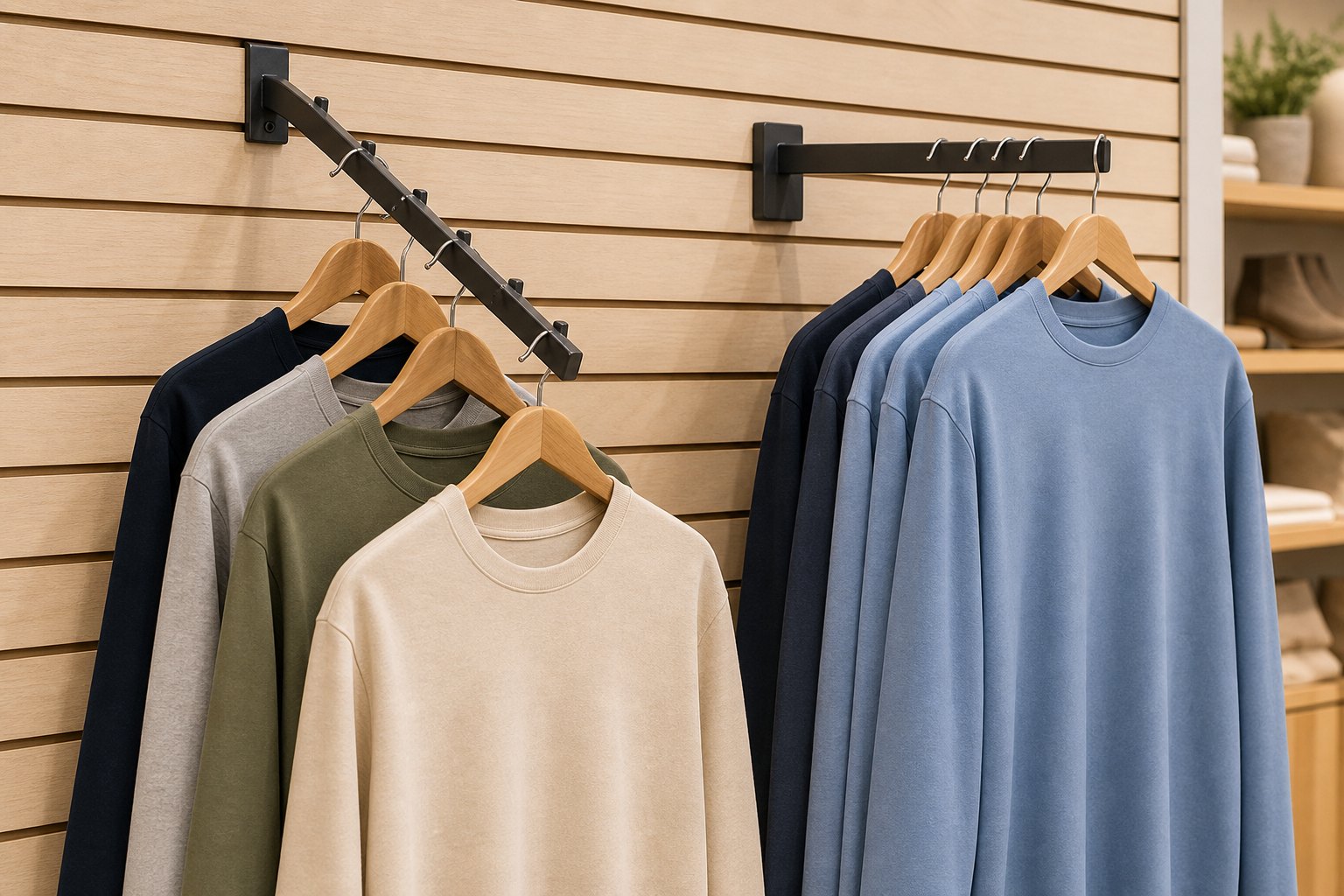
RDUSA's slatwall faceouts category currently includes straight-arm and several waterfall directions. Confirm the exact arm length, attachment, shape, finish, and product suitability before ordering.
Waterfalls vs Straight Arms at a Glance
| Decision factor | Waterfall arm | Straight arm or faceout |
|---|---|---|
| Presentation | Several garments displayed at stepped positions | Focused front-facing or compact hanging run |
| Best use | Color stories, outfit groups, visible variety | Feature item, size run, simple faceout |
| Visual effect | More product is visible from the aisle | Cleaner, quieter projection |
| Planning priority | Keep each step readable | Control depth and product quantity |
| Main risk | Can look busy when overloaded | Rear garments may be less visible |
When Waterfall Arms Work Best
Waterfall arms use multiple stops, balls, hooks, or holes to separate hangers along a descending arm. The stepped arrangement lets shoppers see more than the first garment.
Waterfalls are useful for:
- coordinated tops in several colors
- outfit stories
- new-arrival groups
- small collections that deserve visible variety
- apparel walls viewed from an angle
The format can create a strong visual rhythm, especially when garments are arranged from light to dark, short to long, or by coordinated color.
When Straight Arms Work Best
Straight arms extend products outward from the wall in a simpler line. Depending on the product, they can support a focused faceout, a compact size run, or a small hanging group.
Straight arms are useful for:
- one featured garment facing the aisle
- clean minimalist apparel walls
- size runs where the lead item identifies the style
- small zones between shelves
- departments that need simpler hardware
They create less visual stepping than waterfalls, which can help a wall feel calmer.
Compare Visibility From the Main Aisle
Waterfalls are designed to expose several hanger positions. That helps shoppers understand color or style variety without moving every garment.
Straight arms emphasize the lead garment. The items behind it may require more browsing. That can be acceptable for basics or size runs, but it is less effective when each variation needs immediate visibility.
Stand at the real shopper approach angle. A wall that looks balanced from directly in front may hide products from the aisle.
Compare Browsing Behavior
Waterfalls encourage visual scanning across several garments. Straight arms encourage shoppers to move through a tighter group.
Choose based on the decision customers make:
- use stepped visibility when color and style comparison matter
- use a straight run when size selection is the main task
- use a faceout when one garment should lead the story
- use a hangrail for longer side-hanging capacity
RDUSA's slatwall hangrails may be a better comparison when the goal is a substantial hanging run rather than a small faceout group.
Product Density and Spacing
Waterfalls lose their advantage when every position is overloaded. Garments overlap, hanger shoulders collide, and the stepped presentation becomes a dense block.
Straight arms also need limits. Too many garments create weight, depth, and browsing problems. Use product-specific capacity guidance and confirm the wall system rather than relying on a generic quantity.
Plan enough horizontal spacing that neighboring arms do not overlap. Check long sleeves, wide jackets, and larger sizes, not only a small sample garment.
Coordinate With Shelves and Signage
Faceouts often sit between folded-product shelves, signage, or hanging runs. Keep the wall hierarchy clear:
- feature message or sign
- lead garment
- supporting color or size range
- folded stock or accessories
Waterfalls can carry the visible assortment while nearby shelves hold folded inventory. Straight arms can create clean punctuation between wider side-hanging sections.
When a Mixed Wall Is Stronger
A mixed wall often answers the comparison better than choosing one arm throughout the department. Use a waterfall near the start of a collection to show color or outfit variety, then use straight arms for priority garments and compact size groups. Repeat the pattern consistently so shoppers understand the wall. Before ordering, sketch each accessory position with realistic garment widths and confirm that shelves, signs, and neighboring arms do not overlap.
Hardware Shape and Compatibility
RDUSA lists several faceout forms, including L-shape straight arms, round-hole waterfalls, hook waterfalls, ball waterfalls, rectangular faceouts, pipe faceouts, and tube faceouts. These names describe different physical products, not interchangeable styling labels.
Confirm:
- attachment type
- panel compatibility
- arm length
- hanger type
- finish
- product weight and projection
- required quantity
Common Merchandising Mistakes
- filling every waterfall position with bulky garments
- using straight arms where shoppers need immediate color visibility
- placing arms too close for sleeves and jackets
- mixing shapes and finishes without a wall plan
- ignoring shopper approach angle
- using generic load assumptions
Buyer Checklist
Prepare:
- garment type and hanger dimensions
- typical garment width and weight
- number of colors and sizes
- desired faceout versus side-hanging presentation
- slatwall panel and insert details
- hardware finish
- wall dimensions and neighboring shelves
- quantity and delivery location
Use Samples & Quotes for a coordinated accessory request.
Frequently Asked Questions
Are waterfall arms better for showing colors?
Usually, because stepped positions expose several garments. The benefit disappears if the arm is overloaded.
Are straight arms only for one garment?
No. The exact product may hold a small group, but capacity and use should be confirmed for the selected arm and wall.
Can both be used on one wall?
Yes. Waterfalls can show variety while straight faceouts highlight priority items.
What is the difference between a faceout and a hangrail?
A faceout projects a smaller group outward from the wall. A hangrail creates a longer side-hanging run.
Which option saves more space?
That depends on arm length, garment width, spacing, and product quantity. Measure a realistic loaded mockup.
Final Recommendation
Choose waterfalls when several garments need immediate stepped visibility. Choose straight arms when the wall needs a cleaner faceout or compact hanging group. Use both when the merchandising plan includes visible variety and focused feature products.
Review current slatwall faceouts and waterfalls, then submit garment dimensions and quantities through Samples & Quotes.
Apparel Merchandising Resource
For broader retail planning context, the National Retail Federation publishes retail research and store-operation resources for retailers.