
Custom Wall Display Cases for Retail Stores
When a standard catalog case leaves an awkward gap, conflicts with the store design, or cannot support the intended merchandise, a custom wall display case may be the better route. For those projects, custom wall display cases still require the buyer to confirm the case dimensions, finish, access, lighting, and wall conditions before production.
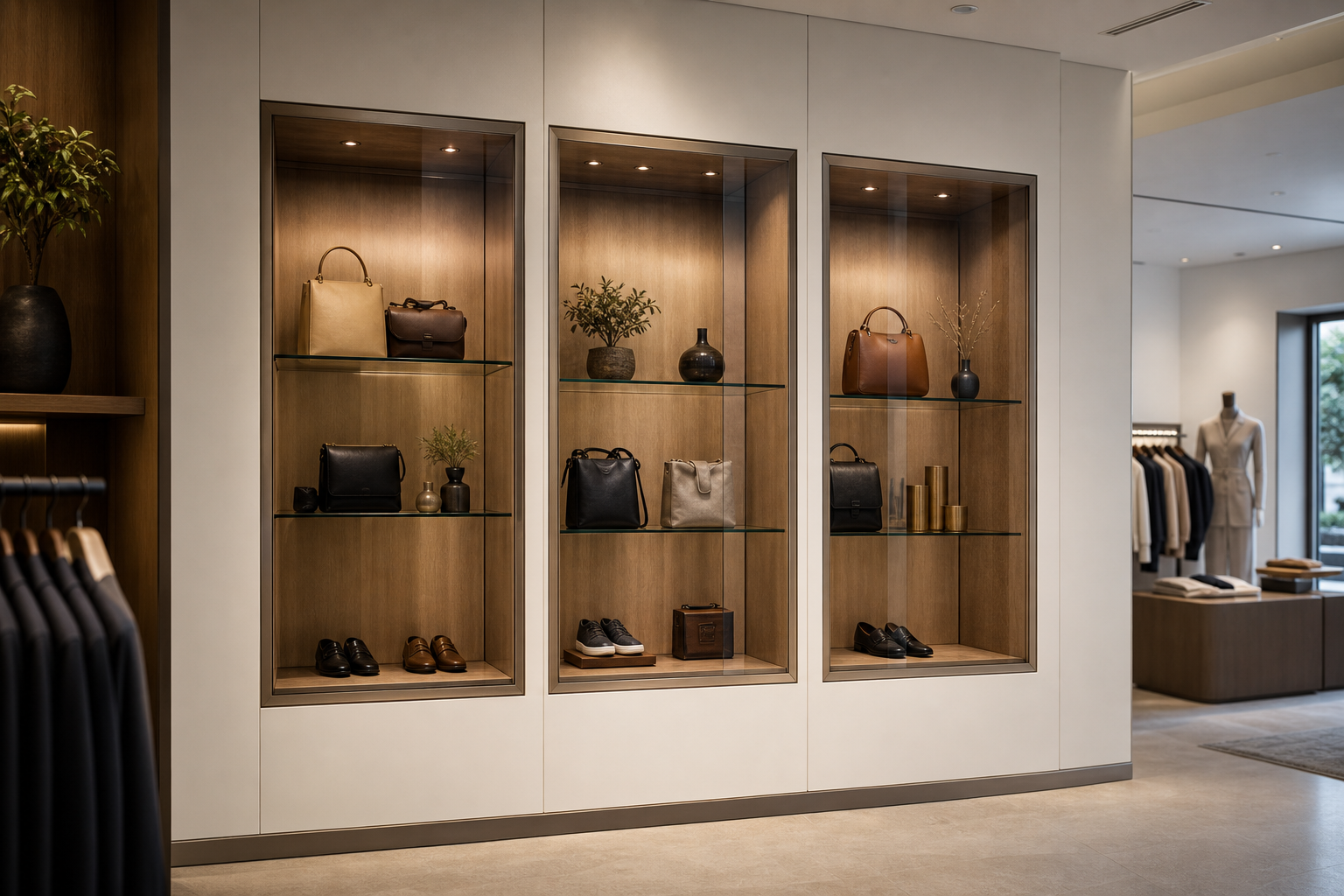
RDUSA's current wall display cases page covers the standard wall-case family. The related wall display case buyer guide explains the broader category. This guide narrows the decision to custom work for stores that need more control over fit, finish, or architectural integration.
Quick Buyer Comparison
| Decision factor | Custom wall display case | Standard wall case |
|---|---|---|
| Fit | Matches a specific wall bay or built-in opening | Works when the wall can accept the standard footprint |
| Brand look | Can feel integrated with millwork and surrounding fixtures | Usually reads as a stocked fixture rather than a built-in feature |
| Planning effort | Needs more measurement, drawings, and approval | Faster to specify and quote |
| Best use | Feature wall, premium brand story, irregular bay | General retail display and repeatable rollout |
When Custom Is Worth It
Choose a custom wall display case when the display has to do more than hold product. A built-in look can improve the brand story, especially in jewelry, accessories, boutique apparel, museum retail, and gift environments where the case is part of the room design.
Custom also helps when the wall opening is not a standard size. In that situation, a standard case can leave awkward gaps or force the store to redesign the surrounding wall. A custom approach may produce a cleaner result than forcing the wrong case into place, but the complete project cost still needs to be compared.
What to Confirm Before Ordering
Start with the merchandise, then work outward.
- exact wall opening or bay width
- usable interior width, depth, and shelf height
- glazing, shelf count, and lighting
- finish family that matches the surrounding fixtures
- staff access and lock requirements
- wall backing, delivery route, and installation responsibility
Do not let the term custom become a substitute for details. The actual case still has to fit the product and the wall.
Finish and Lighting
Custom wall display cases often succeed because they can coordinate with the store better than a one-size-fits-all case. A black frame can sharpen contrast. A wood finish can warm a boutique. Neutral white can keep attention on the merchandise. Lighting should be checked in the same review, because a custom case that is too dark or too reflective can reduce the value of the display.
Good Store Uses
Custom wall display cases fit especially well in:
- jewelry and accessory retail
- boutique apparel and lifestyle stores
- museum or souvenir retail
- premium gift shops
- feature walls that need a built-in look
If the store needs a larger service area or a counter role, compare the case against cases and counters. If the goal is a smaller focal point, a nearby display pedestal can help build a stronger floor story.
Build a Case Brief Before Asking for Custom Work
A custom case request becomes clearer when the buyer provides a short written brief rather than a photograph and a general size. The brief should identify the merchandise, viewing distance, staff access, security expectations, lighting direction, storage needs, finish context, and the reason a standard case does not solve the problem.
Include a measured wall elevation and photographs taken straight toward the wall and from each approach direction. Mark outlets, switches, baseboards, columns, doors, sprinklers, and any existing millwork that affects the case. If the case is intended to appear built in, show how its top, sides, and base meet the surrounding architecture.
The merchandise schedule should describe representative product sizes, packaging, risers, signs, and the number of items expected in each section. That information helps determine whether the useful display area is realistic and whether shelves, doors, or access points will interfere with the presentation.
Review the Approval Drawing as an Operating Tool
The approval drawing should show more than outside dimensions. Review internal shelf positions, door movement, staff access direction, cable or lighting locations, ventilation needs where applicable, and the clear space required to load and clean the case. Confirm which details are fixed and which remain adjustable.
Ask the store manager or employee who will service the case to review the drawing. A designer may focus on alignment and finish, while store staff notice awkward doors, insufficient tray space, blocked access, or a missing surface for presenting merchandise to customers.
For a long case run, identify each module by location and role. Corners, end conditions, staff openings, and transitions to a counter or wall panel should be documented rather than left for the installer to interpret on site.
Plan Delivery and Installation Before Production
Custom dimensions can create delivery problems if the packaged case cannot pass through the receiving route. Measure doors, turns, elevators, stairs, ceiling restrictions, and the final approach to the wall. Confirm whether the case ships assembled, in sections, or knocked down, and identify who is responsible for unloading, assembly, wall attachment, electrical connection, and final adjustment.
Protect the installation area before delivery and keep merchandise away until the case has been inspected. Check glass, finish, doors, shelves, lights, locks where selected, alignment, and attachment before signing off. Record freight damage or missing components immediately using the carrier and supplier procedures.
The buyer should keep the approved drawing, finish sample, component list, and installation notes together. Those records matter if the store later needs a replacement part, matching addition, or second location.
Compare the Complete Project, Not Just the Case
Custom work may create value when it solves a difficult wall, supports a high-value product experience, or removes the need for several mismatched fixtures. It can also add design, approval, production, freight, and installation work. Compare the total project against the best standard or modular alternative using the same merchandise and site requirements.
If a standard case performs the selling job with acceptable fit and finish, custom work may not be necessary. Reserve customization for requirements that materially affect customer viewing, staff service, architectural fit, security planning, or brand consistency.
Frequently Asked Questions
What makes a wall display case custom?
A case becomes custom when the size, finish, or build has to be adjusted for a specific wall or brand requirement.
Are custom wall display cases always more expensive?
Custom work often adds design, approval, production, freight, or installation steps. Compare the complete custom project with a standard alternative rather than assuming either option will cost less.
Do custom wall display cases need special installation?
Often yes. Wall support, access, and delivery planning should be checked before the order is finalized.
Should I choose custom for every wall case?
No. Use custom only when the wall, merchandise, or brand story needs it.
Where should I start?
Start with the product size, the wall opening, and the finish direction, then request a quote with those details.
Final Recommendation
Choose custom wall display cases when the store needs a built-in look or a nonstandard fit that a stock wall case cannot handle cleanly. Review the current wall display cases range, compare the project against cases and counters, and submit the exact dimensions and finish direction through Samples & Quotes.
Custom Case Planning Resource
The National Retail Federation publishes retail planning and store operations research that can help buyers evaluate fixture decisions in a broader merchandising context.