
Freestanding Slatwall Displays for Retail Stores
Freestanding slatwall displays bring adjustable wall-style merchandising into the sales floor without requiring a permanent perimeter installation. They work best when the store needs product access from multiple sides, flexible placement, or a self-contained display zone for changing assortments.
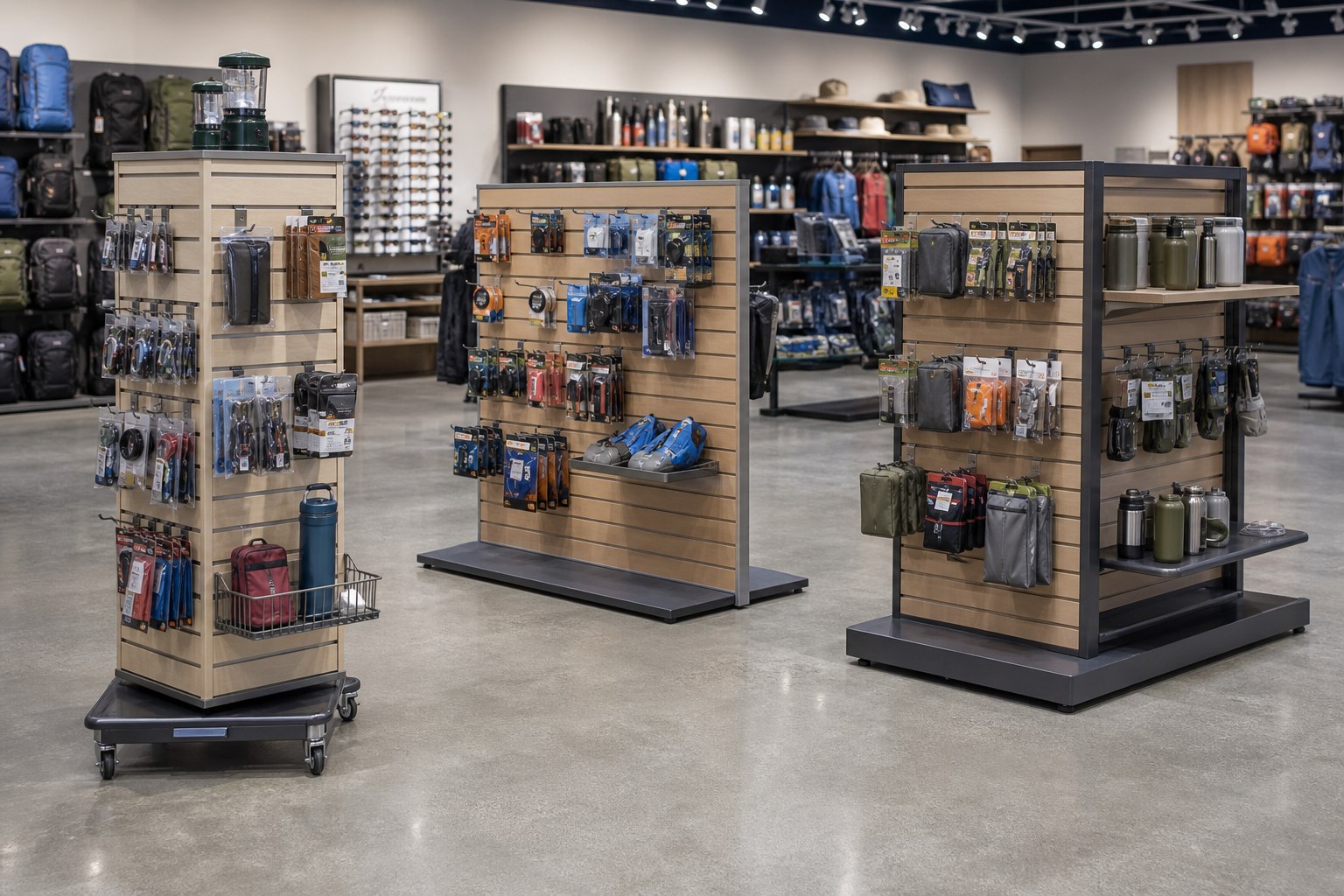
The best fixture shape depends on how customers approach it, what accessories it must accept, how much product it will carry, and whether staff need to move or rotate the display.
Freestanding Slatwall Display Comparison
| Fixture format | Customer access | Best use | Buyer check |
|---|---|---|---|
| Revolver or pinwheel | Several faces in a compact zone | Small packaged goods and browsing displays | Rotation clearance, stability, and reach |
| L unit | Two connected presentation planes | Corners, category separation, or directed traffic | Orientation and hidden-side access |
| T unit | Multiple approaches with a central spine | Department or promotional intersections | Total footprint and aisle circulation |
| H or double-sided unit | Two primary shopping sides | Linear aisles and higher-capacity merchandising | End treatment, base, and cross-aisle width |
What RDUSA Calls These Fixtures
The RDUSA Slatwall Fixtures category contains freestanding floor units with slatwall merchandising faces. Current examples include revolver, L, T, H, pinwheel, and flat steel-stand formats in different materials and groove configurations.
The category name and the search phrase describe the same general buyer need: a slatwall surface that stands on the floor rather than being built directly onto a wall.
Exact dimensions, materials, groove spacing, finishes, bases, and movement features vary by product. Check the selected fixture rather than transferring one product's specification to the whole category.
Choose the Shape From Shopper Movement
A display with four merchandising faces can create useful capacity in a compact area, but only if customers can move around it. A long double-sided unit may fit an aisle better than a rotating square fixture. An L or T shape can help divide departments, but it also creates corners that require deliberate sightline planning.
Draw the fixture at full scale on the floor plan. Include:
- the base and any feet or casters
- merchandise projection from hooks and shelves
- customer standing space
- replenishment access
- rotation clearance where applicable
- nearby doors, tables, racks, and checkout lines
The fixture footprint is not just the panel width. Product and shopper movement enlarge the real operating zone.
Match Accessories to the Product
Freestanding slatwall displays can use hooks, shelves, baskets, faceouts, or other compatible accessories, depending on the panel and groove system. The accessory should follow the merchandise:
- hooks for carded and hanging packaged goods
- baskets for loose or refill-heavy products
- shelves for boxed, folded, or stable items
- faceouts for selected apparel
- sign holders for product and category information
Review slatwall accessories only after confirming compatibility with the exact floor fixture.
Steel, Aluminum, and MDF Slatwall Faces
Material affects appearance, handling, groove spacing, and product suitability. Steel fixtures can create a durable commercial look. Aluminum can reduce visual weight and support closely spaced merchandising in products designed that way. MDF slatwall offers broad finish flexibility and familiar accessory use.
Do not choose material from a single feature. Compare the complete fixture weight, base, finish, accessory system, product load, and relocation needs.
Rotation and Mobility Are Different
A revolving fixture rotates for shopping access. A mobile fixture moves to a different floor location. One capability does not guarantee the other.
If the display must move:
- confirm whether casters are included or available
- verify caster locks
- review the safe moving process
- remove unstable merchandise before relocation
- confirm floor transitions and thresholds
If it rotates, keep product projection within the planned clearance and avoid uneven loading that makes the fixture feel unbalanced.
Capacity Versus Visibility
Freestanding displays can carry more merchandise than their footprint suggests because they use vertical surfaces. That capacity can become a problem when every groove is filled.
Leave enough space for product groups to read clearly. Put high-priority merchandise near comfortable eye and hand levels. Keep heavier products lower where the system and accessory guidance permits. Use the upper area for visible, lighter presentation rather than inaccessible backup stock.
Test One Loaded Fixture Before a Larger Order
For a multi-unit order, test one representative fixture with the real merchandise and planned accessories. Include packaging, signs, shelf projection, baskets, hooks, and the amount of stock expected during normal operation. The loaded fixture can occupy much more space than the empty frame suggests.
Observe customers or staff approaching each intended shopping face. Check whether products hide behind corners, whether inner faces are difficult to browse, and whether the display blocks important wall merchandise or service sightlines.
Ask staff to replenish and reset the fixture. Record how easily they can reach every face, remove accessories, maintain spacing, and move overstock. A high-capacity display creates little value if the least accessible faces remain empty or disorganized.
Plan Receiving, Assembly, and Floor Protection
Confirm packaged dimensions, freight method, delivery route, assembly responsibility, and the space required to build the fixture. Measure doors, elevators, turns, and the final sales-floor location.
Protect finished flooring during assembly and use the specified levelers, glides, or mobility components for the selected product. Freestanding does not mean the fixture should be pushed across the floor while loaded.
Inspect panels, edges, bases, hardware, and accessories before merchandising. Keep the instructions and component list available for future resets or relocation.
Document the Accessory Schedule by Face
Create a face-by-face plan showing which products, hooks, shelves, baskets, and signs belong on the fixture. This reduces unused hardware and gives store teams a repeatable merchandising standard.
For seasonal use, prepare an alternate layout using the same safe, compatible accessory set. If the alternate product mix requires different shelf depth, hook length, or capacity, confirm it before the campaign rather than improvising after stock arrives.
Buyer Checklist
Before ordering freestanding slatwall displays, confirm:
- revolver, L, T, H, pinwheel, or flat format
- overall dimensions and operating footprint
- shopping sides and customer approach
- slatwall material and groove spacing
- compatible hooks, shelves, baskets, and faceouts
- merchandise projection and expected loads
- base stability and floor leveling
- rotation or mobility requirements
- assembly and delivery path
- finish, signage, freight, and replacement parts
Frequently Asked Questions
What is a freestanding slatwall display?
It is a floor fixture with one or more slatwall merchandising faces. It accepts compatible accessories without requiring a permanent wall installation.
Which shape holds the most product?
Capacity depends on fixture dimensions, number of usable faces, accessory layout, and safe loading. A larger H or multi-sided unit may provide more surface, but it also needs more floor clearance.
Are all freestanding slatwall displays mobile?
No. Some rotate, some can be ordered or fitted with movement features, and others are intended to remain in place. Confirm the exact product.
Can standard slatwall accessories be used?
Many fixtures accept common slatwall accessories, but groove spacing and material can differ. Verify compatibility before ordering accessories.
Are freestanding displays good for pop-up stores?
They can be useful when permanent wall construction is not appropriate, but the buyer should compare fixture weight, assembly, transport, and stability.
Final Recommendation
Choose a freestanding slatwall display from the customer path outward. Select the fixture shape, then confirm product access, real operating footprint, material, accessories, stability, and movement requirements. Compare two common floor formats in Slatwall H Units vs Pinwheel Displays, then use Samples and Quotes for configuration and freight planning.
Freestanding Display Planning Resource
The National Retail Federation publishes store-operations research that can support fixture and floor-planning decisions.